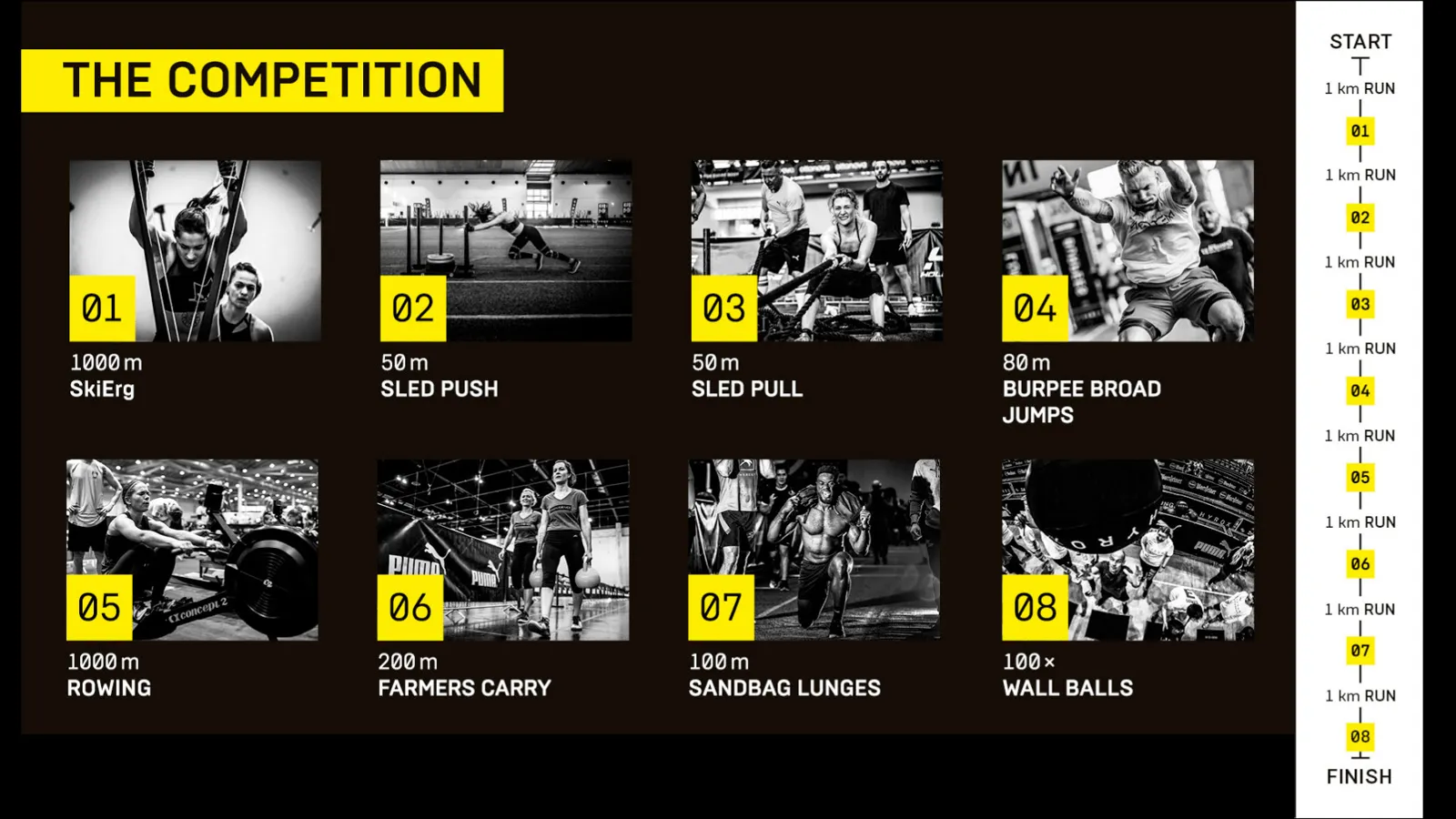


Women race the same eight stations over the same 8 km as men, with different loads and a lower wall ball target.
Below is the specification for each women’s division, and what finish times actually look like. It comes from 100,281 Open Women’s results and 112,395 women’s doubles results.
The weights, division by division
From the HYROX 2026/27 rulebook:
| Open Women | Pro Women | |
|---|---|---|
| SkiErg | 1000m | 1000m |
| Sled push | 102kg total | 152kg total |
| Sled pull | 78kg total | 103kg total |
| Burpee broad jumps | 80m | 80m |
| Row | 1000m | 1000m |
| Farmers carry | 2 × 16kg, 200m | 2 × 24kg, 200m |
| Sandbag lunges | 10kg, 100m | 20kg, 100m |
| Wall balls | 4kg to a 2.7m target, 100 reps | 6kg to a 2.7m target, 100 reps |
Sled weights include the sled itself, which is why they look large. Pro Women carry the same loads as Open Men, but throw to the 2.7 m target.
Women’s doubles uses the Open Women loads, split between two athletes. Pro Doubles Women uses the Pro Women loads.
Mixed doubles uses the Open Men’s loads, including a 6 kg wall ball for both partners. The woman throws to the 2.7 m target, the man to 3.0 m.
Anyone can enter Pro. HYROX needs no qualifying time for any division at a regular race. Pick the loads you have trained for.
Two differences are worth building into training. The wall ball target is 2.7 m, not 3.0 m. And the Open sandbag is 10 kg, so the lunges are more about repeated lunging than about load.
What a good time looks like, by age
From 100,281 Open Women’s finishes. Top 10% is the fastest tenth of the age group, typical is the middle finisher, slowest 10% is the slowest tenth.
| Age group | Finishers | Top 10% | Typical | Slowest 10% |
|---|---|---|---|---|
| 16–24 | 13,597 | 1:17:48 | 1:35:55 | 2:06:08 |
| 25–29 | 22,300 | 1:17:07 | 1:34:26 | 2:04:17 |
| 30–34 | 21,762 | 1:17:13 | 1:34:55 | 2:06:22 |
| 35–39 | 17,342 | 1:18:06 | 1:36:08 | 2:06:58 |
| 40–44 | 11,950 | 1:18:59 | 1:36:53 | 2:07:46 |
| 45–49 | 7,105 | 1:20:04 | 1:38:29 | 2:12:27 |
| 50–54 | 3,590 | 1:22:00 | 1:40:30 | 2:13:21 |
| 55–59 | 1,589 | 1:25:40 | 1:45:26 | 2:21:57 |
| 60–64 | 763 | 1:23:08 | 1:45:47 | 2:17:08 |
| 65–69 | 193 | 1:34:54 | 1:57:23 | 2:37:14 |
| All ages | 100,281 | 1:18:08 | 1:36:08 | 2:07:26 |
Three things stand out.
The typical Open Woman finishes in about 1:36. Finish under that and you are in the faster half of the field. Under 1:18 is the top 10% of the whole division, at any age.
Age costs less than most people expect, until about 55. From 25–29 to 45–49, twenty years, the typical moves by about four minutes. That says a 45-year-old’s limit is training history, not age.
The drop becomes real from 55, where the fields also get much smaller. The masters guide covers what changes and what to do about it.
The spread within an age group dwarfs the spread between them. Inside 30–34 there are 49 minutes between the top 10% and the slowest 10%.
Between the fastest and slowest age-group typical finishes in the table there are about 23 minutes. Your age group tells you little about your potential. Your training tells you a lot.
The other women’s divisions
| Division | Finishers | Top 10% | Typical | Slowest 10% |
|---|---|---|---|---|
| Open Women | 100,281 | 1:18:08 | 1:36:08 | 2:07:26 |
| Pro Women | 16,275 | 1:11:04 | 1:26:40 | 1:54:59 |
| Doubles Women | 112,395 | 1:14:34 | 1:28:16 | 1:49:33 |
| Pro Doubles Women | 14,552 | 1:07:01 | 1:20:01 | 1:41:16 |
Doubles is about eight minutes faster than Open at the typical. The station work is shared but the running is not, which tells you where doubles time is won. The doubles strategy guide covers how to split it.
The Pro Women’s typical of 1:26:40 is nearly ten minutes faster than Open, despite heavier loads at every station. That is not evidence that the weights help.
Pro is a self-selected field. Anyone can enter, so the gap tells you who chooses Pro, not what the loads do.
Where women’s time actually goes
From 98,984 Open Women’s races with full splits, the typical athlete spends 46:46 running, 41:27 at stations and 8:20 in the roxzone.
The stations with the widest gap between the typical and the top 10%:
| Station | Typical | Top 10% | Gap |
|---|---|---|---|
| Burpee broad jumps | 6:48 | 4:47 | 2:01 |
| Wall balls | 6:54 | 4:54 | 2:00 |
| Sandbag lunges | 5:16 | 3:52 | 1:24 |
| Sled pull | 5:52 | 4:29 | 1:23 |
| Sled push | 2:58 | 2:18 | 0:40 |
| Row | 5:33 | 5:02 | 0:31 |
| Farmers carry | 2:21 | 1:53 | 0:28 |
| SkiErg | 5:19 | 4:52 | 0:27 |
Two things stand out in the women’s field.
The sled push is not the problem. At 102 kg the Open Women’s sled moves. A typical time of 2:58, only 40 seconds off the top 10%, makes it one of the cheapest stations in the race.
The sled pull is the sled that costs women time: 5:52 typical, 83 seconds off the top 10%. It rewards technique, rope handling and body weight more than raw strength.
Burpee broad jumps are as expensive as wall balls. In the men’s field wall balls are clearly the biggest gap. In the women’s field burpees and wall balls are level, at about two minutes each.
Both need no equipment, which makes them the best return on training at home.
Training implications
The 4 kg ball to 2.7 m makes wall balls a rhythm and pacing station for most Open Women, not a strength station.
The limit is rarely whether you can throw the ball. It is whether you can throw it 100 times without the sets falling apart.
Train it as capacity: planned sets of 15 to 20 with short, fixed rests from the first rep, as in the pacing guide.
The 10 kg sandbag makes the lunges a leg endurance problem. The judge wants a clear knee touch and a full stand on every rep for 100 metres. Volume of loaded lunging fixes that, not heavier lunging.
And the running is still half the race: 46:46 at the typical. The gap between a typical and a top-10% run total is almost nine minutes, more than the gap on the station total.
Build the block around your date with the plan builder, or start from the ready-made sessions in the strength and running and endurance categories.
Full numbers for every division and age group are in the benchmark tables.