

Get the app
First-time HYROX athletes in the starting pen
First race · start here

How to train for HYROX: your first race

What the race actually asks of you, three tests to see where you are, and a free four-week starter block written by a certified PT.

  • 4 weeks
  • 4 days a week
  • No sled needed
  • Free
  1. 01
    Know the race
    8 runs, 8 stations, and the one skill that decides your time.
  2. 02
    Test where you are
    Three quick tests before you start anything.
  3. 03
    Build the base
    Four weeks that teach the movements and get you running off a station.
Step 1 · the race

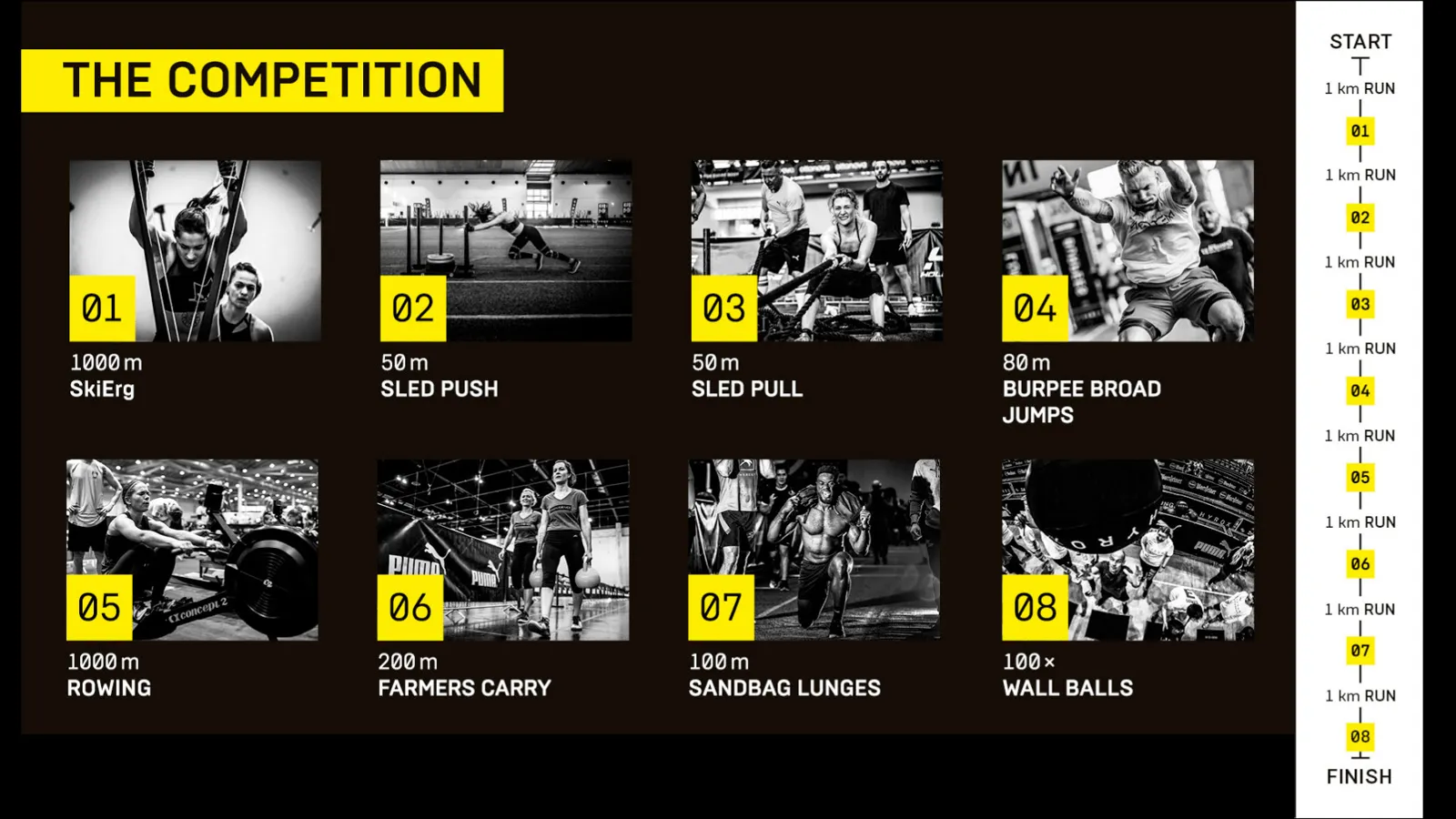
Eight runs, eight stations, clock never stops

Run a kilometre, do a station, run a kilometre, do the next one. Sixteen segments. Fresh, none of the stations is hard. What beginners cannot do is run well straight after one.

Where a beginner's minutes actually go

nobody loses time on the sled. they lose it on the km after the sled.
Run 1 · typical Open Man 4:33 fresh
Run 8 · same athlete 5:55 compromised running, the skill this block trains
Walking between stations 7:42 8:20 for the typical woman

From 709,816 published finishes. The fix for the roxzone costs nothing: know where you are going and keep moving.

Step 2 · the tests

Three tests before you start anything

  1. 01
    Run 5K without stopping
    Any pace you can talk at. Cannot yet? This starter block is exactly where you belong. Do not jump to the 8-week plan.
  2. 02
    100 wall balls for time
    6 kg women, 9 kg men. Over twelve minutes, or stopping for a minute at a time, means wall balls will be the biggest line on your card. Typical man: 7:15.
  3. 03
    1 km straight off a hard set
    20 air squats, 40 walking lunges, then run a kilometre. The gap to your fresh kilometre is your whole problem in one number.
Then pick your race and see how ready you are →
Step 3 · the plan

The free 4-week beginner starter plan

Title Intharat
The Four-Week Sharpener · beginner track · 16 sessions Written by Title Intharat, BSc Sport Science, Certified Personal Trainer · Reviewed by Michael Borman · Updated April 2026

Week 1 learns the movements light. Week 2 adds volume. Week 3 goes race-specific. Week 4 tapers. The point is to finish it still wanting to train.

Beginner track

  1. W1
  2. W2
  3. W3
  4. W4
  • Base
  • Build
  • Peak
  • Race week
Pacing rules for this track5
  • Opening 3 runs: 80% effort to establish sustainable rhythm - avoid the common mistake of 'winning' the SkiErg but losing the race
  • Station approach: Focus on continuous movement over speed - stopping to rest costs massive energy to restart (especially on sleds)
  • Burpee Broad Jumps strategy: This is where races are won or lost - find a robotic rhythm and count in sets of 10
  • Wall Balls breaking: Plan your breaks from the start - 10 sets of 10 with 5-10 second rests beats going unbroken and crashing
  • Mental approach: Every station completed is a victory - completion over speed for your first race
W1 Foundation & Technique Base · 4 sessions · 3-4 hours

This week: Movement quality is everything this week. Master basic patterns like squats, push-ups, and planks with bodyweight or very light resistance. Build your aerobic base with easy-pace running that feels conversational. The goal is learning, not testing limits.

Monday

Foundation Circuit

  • 3 Rounds:
  • — 15 Goblet Squats (8kg women/12kg men)
  • — 10 Push-Ups (knees OK)
  • — 15 Sit-Ups
  • — 200m Row (easy pace)
  • Rest 90 sec between rounds

First workout! Take it easy. Focus on learning movements.
Tuesday

Zone 2 Endurance Run

  • 25 Min Continuous Run
  • Target Pace: 6:30-7:30/km

Easy conversational pace. Walk breaks OK. HR 130-140 bpm.

Wednesday

Rest Day

Thursday

Strength Building

  • 3 Rounds (slow & controlled):
  • — 10 Goblet Squats (8kg/12kg)
  • — 8 Push-Ups
  • — 10 Walking Lunges each leg
  • — 10 DB Rows each arm (5kg/8kg)
  • — 20 sec Plank
  • Rest 2 min between rounds

Add 2-4kg if too easy. Quality over speed.

Friday

Rest Day

Saturday

Run + Wall Balls

  • 3 Rounds:
  • — 400m Run (moderate pace)
  • — 12 Wall Balls (6kg/9kg)
  • — Rest 2 minutes

Learning to run when tired. Wall ball to 3m target.

Sunday

Complete Rest

  • Complete all 4 workouts this week
  • Run 25 minutes continuously without walking

Week 1 is all about establishing your foundation without overwhelming your system. Your body is learning new movement patterns while adapting to a structured training routine. Don't worry about performance, focus entirely on learning proper form and building the habit of consistent training. This week sets the tone for everything that follows, so patience and attention to detail are your best friends.

W2 Building Volume Build · 4 sessions · 4-5 hours

This week: Progressive volume increases with continued emphasis on perfect form. Add light HYROX station practice to familiarize yourself with the movements. Extend cardio sessions gradually while maintaining that easy, conversational pace throughout.

Monday

Station Practice

  • 20 Min AMRAP (As Many Rounds As Possible):
  • — 200m SkiErg or Row
  • — 50m Farmer's Carry (12kg/16kg per hand)
  • — 8 Burpees (step back OK)
  • Rest as needed

Learning stations. Goal: 5-7 rounds.

Tuesday

Progressive Run

  • 30 Min Progressive:
  • 0-10 min: Easy pace
  • 10-20 min: Steady pace
  • 20-30 min: Easy pace

Build gradually. Goal: 4-5km total.

Wednesday

Rest Day

Thursday

Strength Progress

  • 6 Sets:
  • — 8 KB Swings (12kg/16kg)
  • — 6 DB Press (5kg/8kg each hand)
  • — 10 Goblet Squats (12kg/16kg)
  • — 8 Push-Ups
  • Rest 2 min between sets
  • Finisher: 2x20 sec Wall Sit

Increase weight if completing all reps easily.

Friday

Rest Day

Saturday

Sled Introduction

  • 4 Rounds:
  • — 300m Run (steady pace)
  • — 15m Sled Push (50kg women/70kg men)
  • — Rest 2-3 minutes
  • Sub if no sled: 20 Walking Lunges

First time with sled. Stay low, drive with legs.

Sunday

Complete Rest

  • Complete 5+ rounds in the 20-min AMRAP
  • Push sled for 15m without stopping

Week 2 introduces your first real training progression. Your body has started adapting to the new movement patterns, and now we can safely increase training volume. You might feel slightly more fatigued this week, this is normal and expected. Focus on consistency and trust that adaptation is happening even when workouts feel challenging.

W3 Intensity Introduction Peak · 4 sessions · 4-5 hours

This week: Peak training stress with smart progression. Practice HYROX stations with race-similar weights as your fitness allows. Longer cardio sessions that start building toward the endurance demands you'll face on race day.

Monday

Higher Intensity

  • 4 Rounds For Time:
  • — 300m Row
  • — 12 Wall Balls (4kg/6kg)
  • — 8 Burpee Broad Jumps
  • Cap: 25 minutes

Push harder today. Break wall balls if needed.

Tuesday

Tempo Run

  • 35 Min Total:
  • — 10 min warm-up
  • — 3x5 min threshold
  • — 2 min easy between
  • — 5 min cool-down

Threshold = comfortably hard. HR 150-160.

Wednesday

Rest Day

Thursday

Race Weights

  • Practice with race weights:
  • 3 Sets:
  • — 8 Deadlifts (40kg/60kg)
  • — 6 DB Push Press (8kg/12kg each)
  • — 10m Walking Lunges (10kg/15kg sandbag)
  • Rest 2 min
  • Finisher: 50m Farmers Carry (16kg/24kg each)

Race week - maintain these weights, don't increase.

Friday

Rest Day

Saturday

Mini Simulation

  • HYROX Mini Test:
  • — 1km Run
  • — 500m SkiErg or Row
  • — 25m Sled Push (100kg/120kg)
  • — 500m Run
  • — 25m Sled Pull (80kg/90kg)
  • — 500m Run
  • — 40 Burpee Broad Jumps
  • — 500m Run
  • Time Cap: 45 min

Half distance simulation. Pace yourself!

Sunday

Complete Rest

  • Complete mini simulation under 45 minutes
  • Use race weights for wall balls (6kg/9kg)

Week 3 is where everything starts clicking together. Your body has adapted to the training stress, and you should feel noticeably stronger and more confident. This is your peak training week, embrace the challenge while maintaining excellent form. You'll be surprised by what you're capable of.

W4 Taper & Race Prep Race Week · 4 sessions · 2-3 hours

This week: Volume reduction with sharpness maintenance. Light race simulation to build confidence and practice pacing. Focus heavily on race day logistics, mental preparation, and visualization of successful performance.

Monday

Light Practice

  • 3 Rounds @ 50% effort:
  • — 150m SkiErg
  • — 10 Wall Balls
  • — 100m Farmers Carry
  • — 5 Burpee Broad Jumps

Easy movement practice. 20-25 min total.

Tuesday

Shakeout Run

  • 20 Min Total:
  • — 15 min easy run
  • — 4x50m strides @ 80%
  • — 5 min cool down

Stay fresh. Should feel energized.

Wednesday

Complete Rest

Thursday

Race Activation

  • Light Activation:
  • — 10 min easy bike/walk
  • — Dynamic stretching
  • — 2x5 Wall Balls, Burpees, Squats
  • — 2x100m easy run

20 min max. Visualize success.

Friday

Complete Rest

Saturday

Complete Rest

Sunday

RACE DAY!

  • Race Day Timeline:
  • -3 hrs: Breakfast
  • -90 min: Arrive venue
  • -60 min: Warm-up
  • -30 min: Practice stations
  • -15 min: Final prep
  • GO TIME!

Start conservative. Trust your training. Enjoy!

  • Feel fresh and ready for race day
  • Execute perfect technique on all movements

Week 4 is about bringing everything together for race day. The hard training is done, now we focus on maintaining fitness while ensuring you feel fresh and confident. This week is about race preparation, mental readiness, and trusting the process you've been following.

"conversational pace" means you can say a full sentence. if you can't, slow down. that is the instruction.
Send me the 4-week starter plan
All four weeks in one email, so it is on your phone at the gym.

The RoxHype app

Your first block, rebuilt every week around what you actually did.

Miss a session, change gyms, lose a week to work: the app reshuffles the rest instead of leaving you to guess.
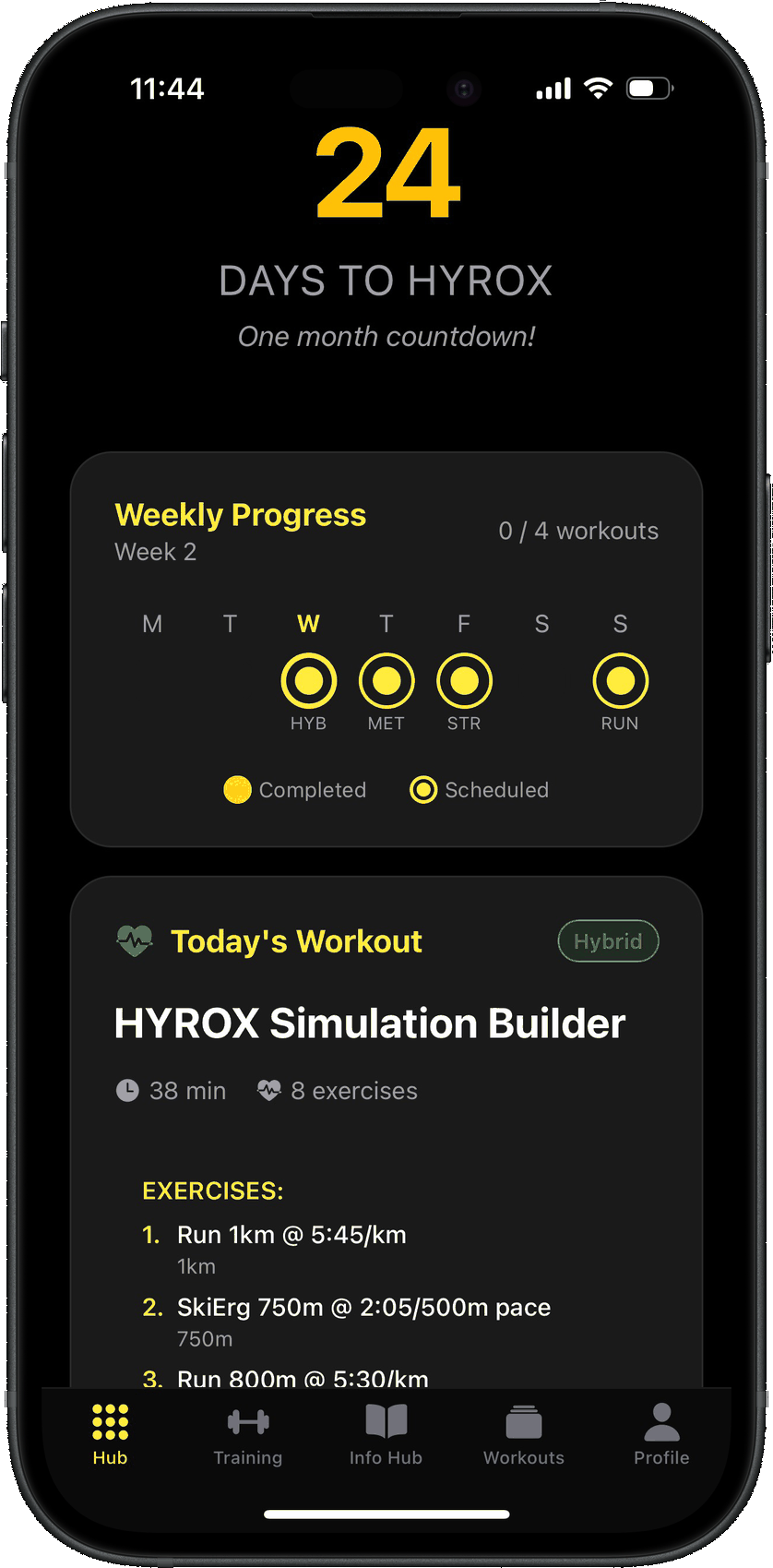
  • Built from your race date and level
  • Rebuilt every week from what you did
  • Every station, every run, timed in the app
first race? it knows.
The RoxHype app: today's workout and the race countdown
Race week

The last seven days before your first race

WhenDoWhy
7 days outLast hard sessionThis is your final high-intensity workout. It should feel challenging but not exhausting. You're using the fitness you've built, not trying to build more.
5-6 days outEasy sessions onlyLight movement keeps your systems active while promoting recovery. Focus on movement quality and technique rehearsal rather than fitness stress.
3-4 days outRace simulationShort, sharp efforts that calibrate your pacing and build confidence. This is about strategy practice, not fitness testing.
1-2 days outComplete restRest and get your head ready. A short walk is fine, nothing that makes you tired.
Race dayExecute your planYour preparation is complete. Focus on executing your strategy with confidence and enjoying your achievement.

No sled at your gym? Swap it.

Sled push Heavy walking lunges, or a plate pushed on a towel across a smooth floor.
Sled pull Seated or bent-over rows, paired with a backwards walk up a hill.
SkiErg A rower with a hard damper, or banded straight-arm pulldowns for volume.
Wall balls Dumbbell thrusters. But find a real ball if you can: this is the station to prioritise.
Sandbag lunges A weighted vest, a barbell in the front rack, or a heavy dumbbell at the chest.
Every swap, with the reasoning The full substitution list, and the builder applies them automatically.

Questions people ask

How long do I need before my first HYROX?
Eight weeks if you can already run 5K, sixteen if you cannot. Technique and pacing change in two to four weeks. Strength-endurance, the ability to do eighty lunges and still run, needs six to eight. Aerobic base, the thing that keeps run 8 close to run 1, takes three months and up. That is what the four-week block below is for: it gets you to the point where the 8-week plan is worth running.
What is a realistic first-race goal?
The typical Open Men's finish is 1:27:49 and the typical Open Women's is 1:36:08, and those typical finishes include a lot of first-timers. The slowest tenth of Open Men take more than 1:57:37. There is nothing wrong with being there on a first attempt: the cut-off is generous and walking is allowed. Train properly for eight weeks and finishing inside the middle of your division is realistic.
My gym has no sled. Can I still do this?
Yes. Sled push: heavy walking lunges or a plate pushed on a towel. Sled pull: rows plus a backwards hill walk. SkiErg: a rower with a hard damper. Wall balls: dumbbell thrusters, but find a real ball if you can, it is the longest station for most beginners. Sandbag lunges: a weighted vest or a dumbbell at the chest. The full list is in training without a sled.
What do I do after the four weeks?
Retake the three tests. If you can run 5K continuously and a set of wall balls no longer ends your session, go straight to the beginner track of the 8-week plan. Same author, same structure, it picks up where this leaves off. Race further out than that? Run the 12-week or 16-week version.
What happens on race day?
Most first-race panic is logistical, not physical. Read what actually happens on race day and the rules and penalties: a no-rep on wall balls or a missed lane on the sled costs more time than a fortnight of training wins back.

Where next

Get the app