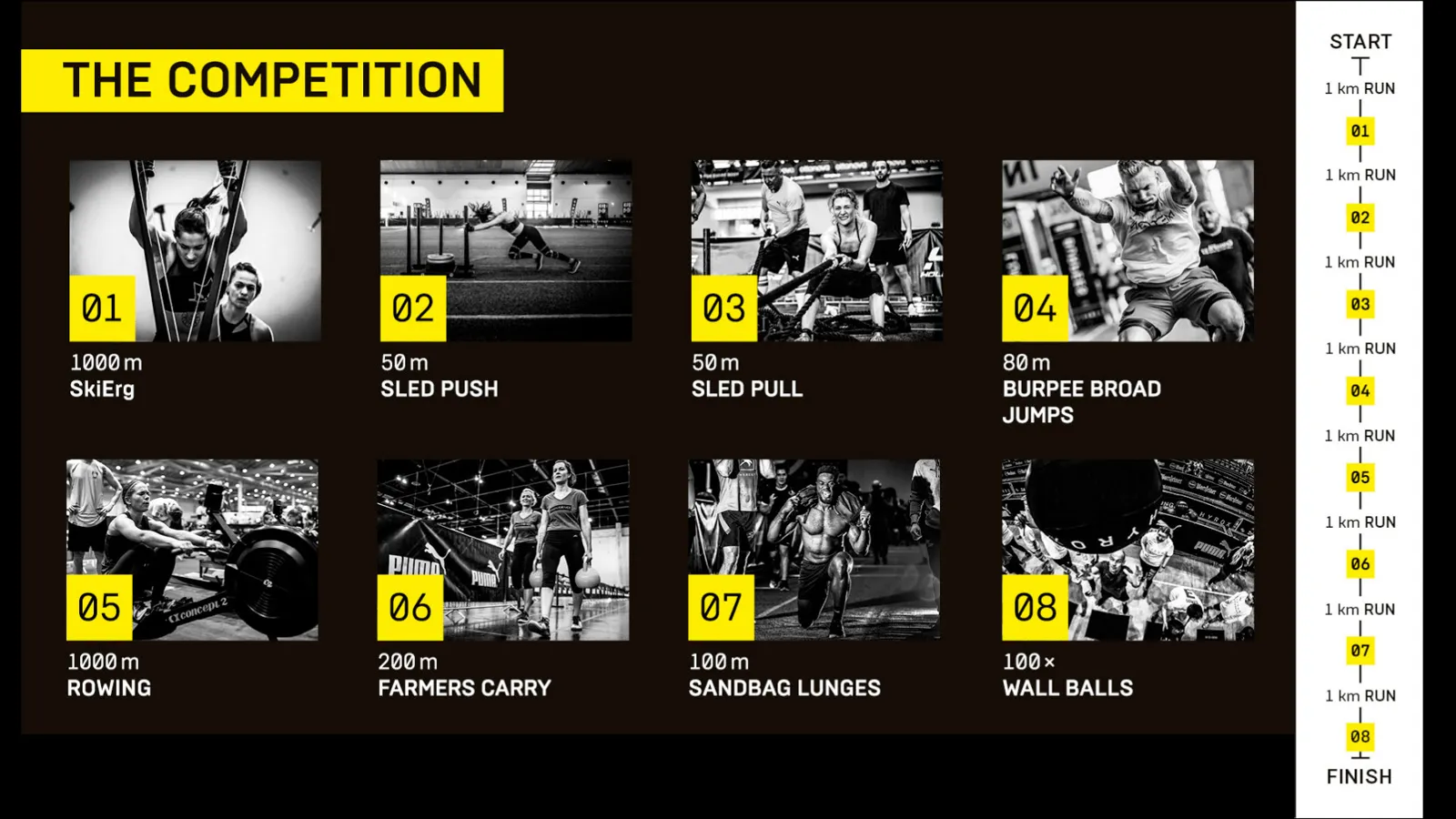


Most gyms do not have a sled. Fewer still have a SkiErg, a rower, a 20 kg sandbag and a wall ball target at 3.0 m as well.
It is the most common problem in HYROX training, and it is smaller than people think. Substitute for the demand, not the movement, then test whether the transfer worked.
Substitute the demand, not the movement
Every HYROX station makes a specific demand. Get the demand right and the movement barely matters.
| Station | The demand | Substitution |
|---|---|---|
| Sled push 50m | Hard horizontal leg drive, 45–90 sec, heart rate to the ceiling | Heavy walking lunges, or steep-hill sprints of 20–30 sec |
| Sled pull 50m | Back of the body under constant tension, grip, hand-over-hand rhythm | Bent-over rows + backwards hill walk, or band rows to failure |
| SkiErg 1000m | Steady full-body aerobic work, 4–6 min, lats and trunk | Band lat pull-throughs, or burpee-to-overhead-reach intervals |
| Row 1000m | Steady legs-then-back aerobic work, 4–6 min | 800m run at hard effort, or 5 min of hard cycling |
| Wall balls 100 | Repeated squat-to-press under fatigue, rhythm, shoulders | Dumbbell thrusters to a fixed overhead mark |
| Farmers carry 200m | Grip endurance and a steady trunk while walking fast | Heavy dumbbell or kettlebell carries, anything you can hold |
| Sandbag lunges 100m | Loaded lunging with a shifting weight high on the body | Dumbbell front-rack walking lunges, or a weighted backpack |
| Burpee broad jumps 80m | Repeated full-body extension plus jumping forward | No substitution needed. This station needs nothing |
Note the last row. It is the second-widest station in the race: typical 5:38 for Open Men, slowest 10% 8:31. And it needs no equipment at all.
If you train nothing else at home, train burpee broad jumps.
Getting the load right
A substitution only works if the effort is similar. Three rules.
1. Match the time, not the reps. In Open Men, the top 10% finish the sled push in 2:25 and the slowest 10% take 4:26. So your substitute should be 2:30 to 4:00 of continuous hard work.
Twelve heavy lunge steps is not a sled push. Four sets of 20 heavy lunge steps with 20 seconds between, about three minutes in all, is close.
2. Match where it burns. A sled push burns in the quads and leaves you gasping. If your substitute burns in your shoulders, it is the wrong exercise or the wrong load.
Heavy walking lunges and 20–30 second hill sprints both give the right mix of leg burn and breathing. Step-ups and the leg press do not.
3. Match the cost afterwards. The point of the sled is that you then have to run a kilometre. Follow your substitutes with running in at least some sessions, or you train the movement without what makes it hard.
Practical loads
- Sled push substitute: walking lunges holding dumbbells at roughly 20–25% of bodyweight in total, in blocks of 20 steps. Or a 6–10% hill, 20–30 second efforts, walk down.
- Sled pull substitute: bent-over rows at a weight you can move 12–15 times, for 4–5 sets. Alternate with 40 m of walking backwards up a slope. The backwards walk is the part people skip, and it copies the position.
- Wall ball substitute: dumbbell thrusters, with one dumbbell held in both hands at about your ball weight, or two lighter ones. Balls are 4 kg for Open Women, 6 kg for Open Men and Pro Women, 9 kg for Pro Men. Hit a fixed overhead mark every rep, or the substitute is worthless.
- SkiErg substitute: band lat pull-throughs anchored high, 30 seconds on and 15 off, for 5 minutes. Or burpee-to-overhead-reach at a steady rate.
- Row substitute: an 800 m run at hard but controlled effort takes a similar time and a similar toll. For HYROX it beats the bike, because running is what you actually have to do.
What substitutions cannot replicate
Be honest about the gaps. They are the ones that surprise people on race day.
Sled friction and body position. No substitute teaches the low, straight-line position that moves a loaded sled on a smooth floor. None teaches how a sled feels when it stops.
If you can reach a sled even twice in a block, use those sessions purely to learn the position.
Rope handling on the sled pull. Hand-over-hand pulling from inside a box, and keeping the rope tidy, is a skill. Rows build the strength. They do not build the skill.
Erg pacing. Pacing to a monitor is learnable. If you can get on a rower or SkiErg at any point, learn what your target 500 m pace feels like rather than going hard.
Wall ball height. A 3.0 m or 2.7 m target changes the movement. If you can find a wall and mark it, use it. Thrusters to an overhead mark are good fitness work and imperfect practice.
How to test whether the transfer worked
This is the part most people skip. It is the only way to know your substitutes are working.
Every four weeks, run a transfer test: a short session with the kit you have, scored on time.
4 rounds for time: 400m run, 20 heavy walking lunge steps, 15 dumbbell thrusters, 10 burpee broad jumps.
Record the total. Then record how much your run slowed between rounds 1 and 4. The second number matters more.
If your run slowdown shrinks block on block, the substitutes are building the ability to run on tired legs. That is what the real stations demand.
If your total improves but the run slowdown gets worse, you are getting stronger at the movements and no better at the race.
If you can get to a HYROX-equipped gym once in the block, do a partial simulation: a 1 km run plus the real sled, SkiErg and wall balls. The sled often feels harder than expected. Adjust the block to what you find.
The rest of the race is free
Half of HYROX is running, and it needs no equipment. The roxzone needs none either: typical 7:42 for Open Men, 11:25 for the slowest 10%.
Burpee broad jumps need nothing, and lunging needs a backpack. Together that is well over half the race, trainable anywhere. A well-built home block can beat a badly built gym one.
Build one around your race date with the plan builder. Choose minimal equipment and every station is swapped for a substitute automatically.
There are ready-made sessions in the no-equipment and travel workouts. The station pages for sled push, sled pull and wall balls have the split data you are training against.