

HYROX is judged, and the judging is consistent enough to train for. Almost every no-rep and penalty comes from the same short list.
Every one of them is avoidable if you know the standard before you arrive. This is that list, station by station, from the 2026/27 rulebook.
The general rules
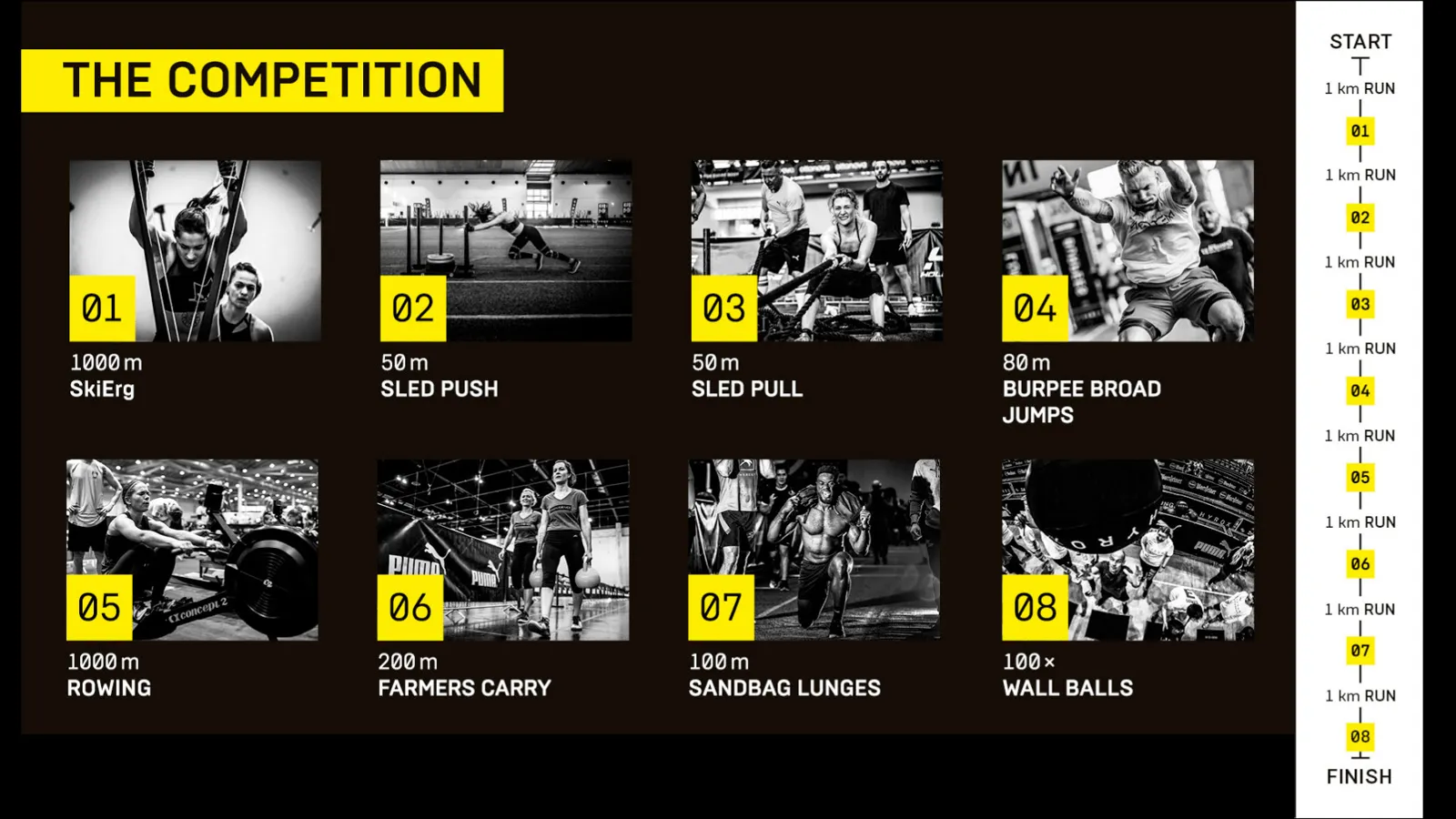
You complete the stations in order. 1 km run, SkiErg, 1 km run, sled push, 1 km run, sled pull, 1 km run, burpee broad jumps, 1 km run, row, 1 km run, farmers carry, 1 km run, sandbag lunges, 1 km run, wall balls.
Do one station out of order and it is a 3-minute penalty. You can make up a missed station before the wall balls. Two out of order, a missed station, a missed run or an unfinished station is a disqualification.
Every station must be finished in full. Leave the SkiErg, the rower or the wall balls before the judge confirms you are done, and you risk being disqualified.
The roxzone is part of the race. It is the corridor between the run course and each station, and it is timed. Go in through the IN arch and out through the OUT arch. The wrong arch costs 2 minutes each time.
Across Open Men, the typical roxzone time is 7:42. The top 10% spend 5:21 in there and the slowest 10% spend 11:25. Nobody judges that six-minute gap, but it is all on your clock.
Lap counting is your job. The runs are laps of a marked course. Any lap screen is only a guide, and running extra laps earns you nothing back.
A missed lap costs 3 minutes on a four-lap course, 5 on a three-lap course and 7 on a two-lap course. Count carefully from run 5, when you are tired.
Fast runners use the fast lane. If you are running 4:00 per km or quicker, use the inside fast lane. Everyone else stays in the outer running lane.
Chalk only where HYROX provides it. Chalk is allowed at the sled pull and the farmers carry, and only HYROX’s own. Your own chalk, carrying chalk to another station, or chalk anywhere else is a 2-minute penalty.
Water is for drinking. Pouring it over your head or body is a 2-minute penalty. So is littering, and so is spitting on the floor.
No outside help. You cannot take a drink, food or kit from anyone except the aid stations. Each time is a 2-minute penalty.
The start is strict. Start in your own wave only, or you are disqualified. Wear your timing chip on your ankle. Be at the start tunnel 10 minutes before your start time, and move off with your wave.
The judges decide. The Lead Race Director has the final word, and penalties can still be added up to 48 hours after the event. Arguing costs more than the rep did.
Station by station
At stations 1 to 7, you get one warning per station for a movement fault. After that, each fault counts as a no-rep and most cost 15 seconds. Wall balls have no warnings at all.
SkiErg — 1000m
A judge resets the monitor before you start. The damper starts at 6, and you can change it as often as you like.
Both feet stay on the platform. You may jump, but your feet must land back on the base plate, and your heels must not touch the floor.
When the monitor says 1000 m, stay on the platform and raise an arm. Leave only when the judge confirms.
It is a pacing station. Typical Open Men time is 4:36 and the top 10% do 4:14. Only 22 seconds separates them, so going hard here buys little and costs the next run. SkiErg splits.
Sled push — 50m
Four lengths of 12.5 m, in the lane a judge gives you. Sled and you start fully behind the white line.
The whole sled must pass the 12.5 m line before you change direction. Stay in your lane and do not interfere with the next one.
Technique, not rules, is where the time is. Stay low on the balls of your feet with a straight line from heel to head.
Typical Open Men time is 3:10, the top 10% do 2:25, and the slowest 10% take 4:26. Sled push technique and splits.
Sled pull — 50m
Four lengths again, pulled from inside a marked racer’s box at each end of your lane. The rules that matter:
- Stay in the box. Do not step on the front or back line of the box while holding the rope.
- Stay on your feet. Pulling from a seated or kneeling position is not allowed.
- The whole sled crosses the line before you run to the other end and pull it back.
- Keep the rope in your lane. It may trail out the back, but not into the next lane.
A tangled rope is your problem and is the biggest time sink here. Chalk is allowed at this station.
Typical 5:03, slowest 10% 7:04. That is a two-minute gap. Sled pull splits.
Burpee broad jumps — 80m
The station where standards get called most. Here is what the rulebook asks for:
- Chest to the floor on every burpee. That means your nipple line clearly touching.
- Stepping is allowed in the burpee. You may jump or step back into it and jump or step out of it. You may also use a knee to get up.
- Hands close to your feet. Place them no more than 30 cm in front of your toes. When you come up, your feet cannot land past your fingertips.
- Two-footed jumps. Both feet take off and land at the same time, with no more than 5 cm between them. No extra steps or shuffles.
- Each section starts from the line. Hands behind the white line, chest on the floor.
- Finish over the line. If either foot lands on the finish line, do one more.
The length of each jump is up to you. Typical Open Men time is 5:38 and the slowest 10% take 8:31. Burpee broad jump splits.
Row — 1000m
The judges reset the monitor. The damper starts at 6 and the foot plates at position 4. You can change both.
You must stay seated until 1000 m is complete and a judge confirms. You may stop, put the handle back in its holder and rest.
Try damper settings in training and know your number before race day.
Typical 4:55, top 10% 4:25. Like the SkiErg, it is a narrow station where hard effort buys little. Row splits.
Farmers carry — 200m
Two kettlebells, from a marked box and back to it. Open Women carry 2 × 16 kg (white), Open Men and Pro Women 2 × 24 kg (grey), Pro Men 2 × 32 kg (black).
- Arms straight by your sides, with both bells carried whenever you move.
- You may put them down to rest, as long as they do not move forward when you do.
- Return them upright to the right box. Otherwise it is a 30-second penalty, unless you fix it before you leave the roxzone.
- Wrong weight? Redo the whole station with the right bells, or be disqualified.
Chalk is allowed here. Typical 2:13, slowest 10% 3:09. The only way to lose real time is a grip that fails. Farmers carry splits.
Sandbag lunges — 100m
Open Women use 10 kg, Open Men and Pro Women 20 kg, Pro Men 30 kg.
- The trailing knee must clearly touch the floor on every rep.
- Stand tall at the top of every rep, hips and knees straight.
- Alternate legs, with no shuffle steps between reps. You may pause between lunges with your feet side by side.
- The bag stays on both shoulders. Putting it down on the floor, a barrier or your feet is a 15-second penalty each time.
- Front foot fully over the line at the end of each lane and at the finish.
Then return the bag to the right area, or take a 30-second penalty. Typical Open Men time is 5:22, slowest 10% 7:57. Sandbag lunge splits.
Wall balls — 100 reps
The strictest standard and the widest spread in the race:
- Pick the right ball. 4 kg (white) for Open Women, 6 kg (grey) for Open Men and Pro Women, 9 kg (black) for Pro Men.
- Start standing tall, holding the ball. You cannot scoop it off the floor and throw it in one move.
- Hips below the knees at the bottom of every squat.
- Hit your target. 2.70 m for women, 3.00 m for men.
- Catch it, or let it drop. If it drops, stand tall with it before the next squat. Catching it off a bounce and carrying on is a no-rep.
- No chalk. Powdered chalk here is a 2-minute penalty.
There are no warnings: every rep is a rep or a no-rep. You may take your shoes off at your target, but you carry them to the finish.
Typical Open Men time is 7:15, the top 10% do 5:00, and the slowest 10% take 11:49. That gap is the single biggest one in HYROX, and most of it is technique and set structure. Wall ball splits and standards.
What penalties actually cost
HYROX does hand out time penalties. Here are the ones from the 2026/27 rulebook that athletes meet most:
| What happened | What it costs |
|---|---|
| Movement fault, stations 1 to 7 | One warning, then usually 15 seconds each |
| Wall ball fault | A no-rep, no warning. Do it again |
| Missed run lap | 3 to 7 minutes per lap, depending on the course |
| Wrong arch into or out of the roxzone | 2 minutes each time |
| Your own chalk, or chalk at the wrong station | 2 minutes |
| Sandbag off your shoulders | 15 seconds each time |
| Bells or bag not returned properly | 30 seconds, unless fixed before you leave the roxzone |
| Water poured over yourself, littering, spitting | 2 minutes |
| Help from anyone outside the race | 2 minutes each time |
| One station out of order | 3 minutes |
| Missed station, missed run or unfinished station | Disqualified |
The hidden cost is the repeat. A no-rep means doing the rep again, in front of a judge, while tired.
At the wall balls that is direct. The typical Open Man spends about 4 seconds per rep, so ten no-reps is roughly 45 seconds. On the sleds and lunges a correction breaks your rhythm, and rhythm is what those stations are made of.
Then there is the time nobody judges: an extra lap, a tangled rope, a damper you never checked. All of it is yours to prevent.
Train the standards, not just the movements
Practise wall balls to a marked target at race height, and lunges to a clear knee touch with the bag never leaving your shoulders. Do burpees with your chest on the floor and two-footed jumps.
Do it every rep, every session, so the standard is automatic when a judge is watching. The race simulation workouts are built around exactly that, and the plan builder puts them in the right week.
Racing as a pair? Doubles has extra rules on running together and handovers, covered in the doubles strategy guide.