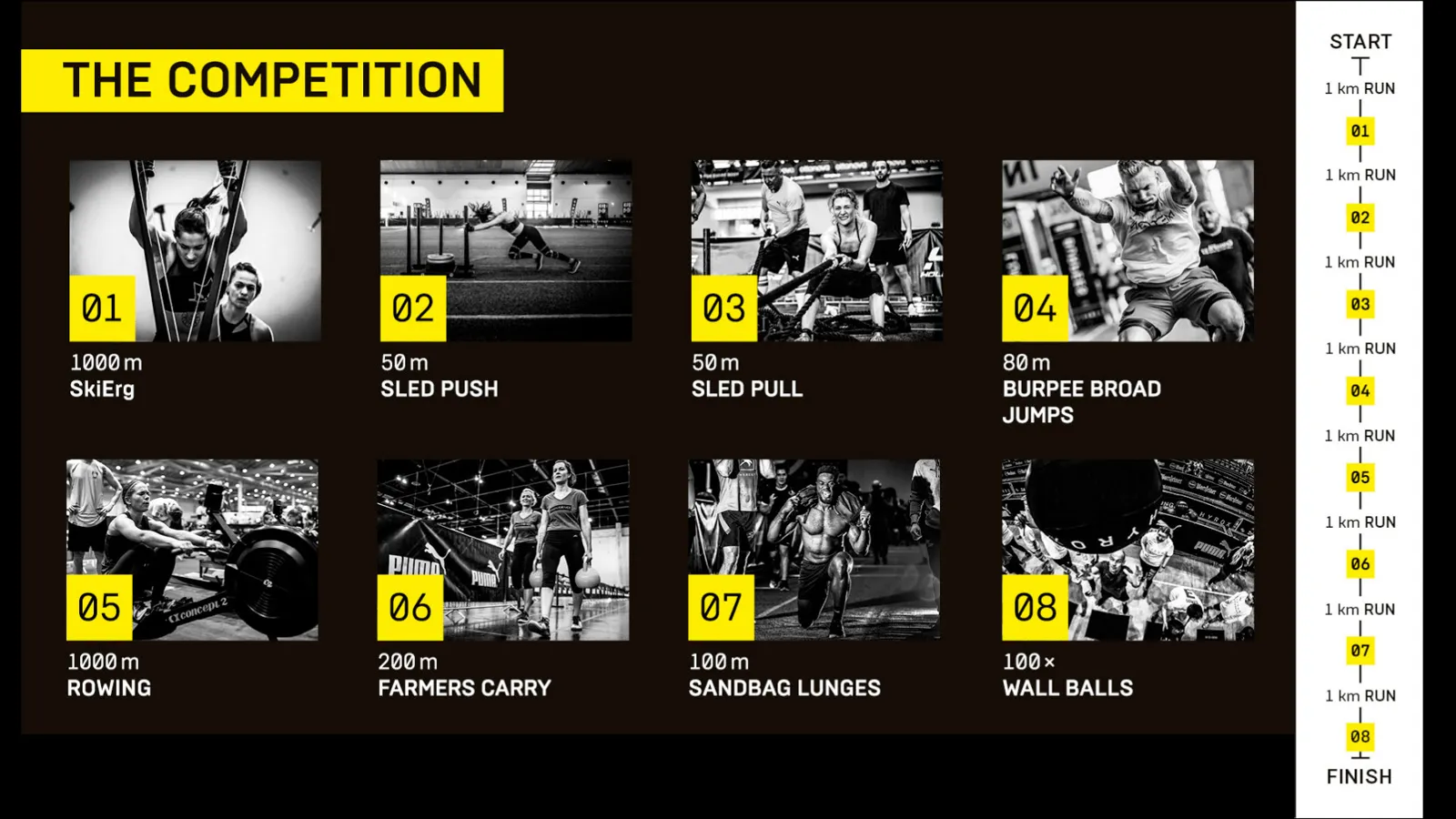


Doubles is not half a HYROX each. Both athletes run all 8 km together, and the stations are shared.
So the race is decided by how you divide work that only one of you does at a time. Across 112,395 women’s doubles finishes the typical is 1:28:16. Across 106,983 men’s it is 1:16:16.
What separates a good doubles time from a bad one is often not fitness. It is the split plan and the handover.
The two rules that shape everything
You run together. Both partners run every 1 km, side by side. If one of you runs ahead, it is a 1-minute penalty. More than three of those and the pair is out of the rankings.
You also enter and leave every station together. So the pair runs at the slower athlete’s pace, and the faster runner’s job is to arrive at each station fresh.
You split each station however you like. Only one of you works at a time, and you can swap as often as you want. The swap is not timed separately. It is just time.
Put those together and the strategy writes itself. Give more of each station to whoever is relatively better at it, and make the swaps cheap.
While you rest, you stay on your feet. Kneeling, sitting or lying down is not allowed during a station. Stay in the working zone and out of other racers’ way.
Splitting when you are asymmetric
The common case is a mismatched pair: one stronger, one with the better engine. Here is how to divide each station.
SkiErg — 1000m
Split by distance, not time. Go 500/500 for an even pair, or 600/400 towards the better skier.
The handles cannot be passed between you, and only the working partner may change the damper. So the incoming partner takes the handles once they are let go.
The SkiErg has a narrow spread. In Open singles only about 22 seconds separates the typical from the top 10%. Swap at a round number so nobody does maths while breathing hard.
Sled push — 50m
Four lengths of 12.5 m. This is where a strength gap matters most, and the right answer is usually not two lengths each.
If one of you moves the sled easily and the other grinds it, go 3–1 or even 4–0 to the stronger athlete. The cost of the weaker athlete’s length is the raised heart rate they carry into the next run.
The resting partner walks directly behind the worker, never in the next lane. Swap at the end of a length. Sled push splits.
Sled pull — 50m
Four lengths again, and the same logic applies. The sled pull rewards body weight and technique more than raw strength.
Your partner cannot help with the rope. The resting partner must stay behind the worker and may not touch the rope with hands or feet. They must also keep off the racer’s box and its lines.
They can talk you through it, though. So the worker tidies their own rope, letting slack fall behind them, and the resting partner calls the count and the swap. Sled pull splits.
Burpee broad jumps — 80m
The station where standards get called most, and the one where splitting helps most. Alternate in short blocks, around 5 reps or 10 metres each, rather than 40 m each.
Short blocks keep both of you fresh enough to hold the standard: chest to the floor, both feet taking off and landing together.
The handover has a rule. The incoming partner puts their hands where the worker’s feet landed, fingers level with their toes. The resting partner walks behind, never alongside.
If the pair is uneven, keep the blocks short and shift the ratio: 8 metres to 12 rather than 40 to 40. Burpee broad jump splits.
Row — 1000m
Go 500/500 with one swap. You cannot pass each other the handle, change the damper for each other or adjust each other’s foot straps.
So agree beforehand whether either of you will change the foot plate at all. Every change is time. A swap is quick if the incoming partner is standing right behind the seat, ready.
Nothing about doubles rewards a hard row. It is a narrow station and the run after it is not.
Farmers carry — 200m
Default to half each. If one athlete’s grip is the limiter, go 120/80, or let the stronger athlete carry most of it with a rest halfway.
You may put the bells down to rest, as long as they do not move forward. At a handover the bells go sideways or backwards, never forwards. A grip that fails mid-length costs more than an uneven split. Farmers carry splits.
Sandbag lunges — 100m
Split by distance, in blocks of 20 to 25 metres. Lunges build up leg fatigue fast. Long blocks wreck whoever takes them, and then you both have to run a kilometre.
The bag must stay on the worker’s shoulders the whole time. Putting it on the floor is a 15-second penalty. So hand it over shoulder to shoulder, passing it sideways or backwards, never forwards.
The incoming partner stands ready, and the bag moves across in one movement. Sandbag lunge splits.
Wall balls — 100 reps
The decisive station, and the one where a strength gap is easiest to use. Do not go 50/50 in two blocks.
Alternate in sets of 10, or 15 and 5 if one athlete is clearly stronger. Short sets let both of you work near your best with real rest between.
No flying handovers. Hand the ball over, or let it drop. If one partner throws and the other catches it in their squat and carries on, that is a no-rep.
The target goes by the athlete: 2.70 m for women, 3.00 m for men. In mixed doubles you both use the 6 kg ball, so know which target is yours. And no chalk here. Wall ball splits and standards.
Handovers: where the seconds actually are
Handovers add up. If a clean one takes three seconds and a messy one fifteen, twenty swaps is a four-minute difference.
Three habits make them cheap:
- The resting partner is always ready. Right behind the worker, facing the right way, hands free. Not recovering ten metres away.
- Call the swap one rep early. “Two more” rather than stopping to look up. The incoming athlete is already moving.
- One person owns the count. Whoever is resting counts out loud. The worker should never be doing maths.
Practise handovers on purpose. They are a skill, they cost nothing to train, and solo plans never include them. The partner and doubles workouts are built around them.
Pacing a mismatched pair
The faster athlete’s instinct is to do more work everywhere. That is usually right at the stations and wrong on the runs.
Running a little slower than your solo pace costs the pair almost nothing, because you move at the slower runner’s pace anyway. Arriving at the sled with a lower heart rate is what lets you take three lengths instead of two.
So a good uneven doubles race looks like this. Run together, conservatively. Bias every station towards whoever is better at it. Keep burpee, lunge and wall ball blocks short enough that neither of you hits failure.
The general pacing principles, including the run fade and the roxzone, are in the pacing strategy guide.
Divisions, weights and age groups
Women’s doubles uses the Open Women’s weights. Men’s doubles and mixed doubles both use the Open Men’s weights, including the 6 kg wall ball.
Pro doubles uses the Pro weights. Your age group is set by the pair’s average age on race day, and your finish time is taken when the second of you crosses the line.
Build it into a block
Doubles needs two things a solo plan does not: sessions side by side at a shared pace, and station work in alternating blocks.
Build the block around your race date with the plan builder. Then run the station days as a pair, with the splits above.