


Station 2 of 8
HYROX Sled push
50 m, run as four lengths of 12.5 m, on a carpeted lane.
- Men typical 3:10
- Women typical 2:58
- 4% of the race
Short and heavy. Body angle, short steps and never stopping matter as much as leg strength.
Open Men
Top 10%2:25Typical3:10Slowest 10%4:26
Open Women
Top 10%2:18Typical2:58Slowest 10%4:00
Time the top 10% win here 45s vs a typical Open Men finisher
Worth training #5 of 8 stations by time to gain · #1 is wall balls
Your number
Where does your split land?
one split doesn't make a race. your worst one usually explains it.
Your sled push split
Is your sled push actually slow?
Type the split from your last race or your last full simulation. See where it sits against real racers.
The RoxHype app
Fix the sled push, then the next one.
A plan weighted toward the splits that are actually costing you time, rebuilt every week.
- Built from your race date and level
- Rebuilt every week from what you did
- Every station, every run, timed in the app
worst split first
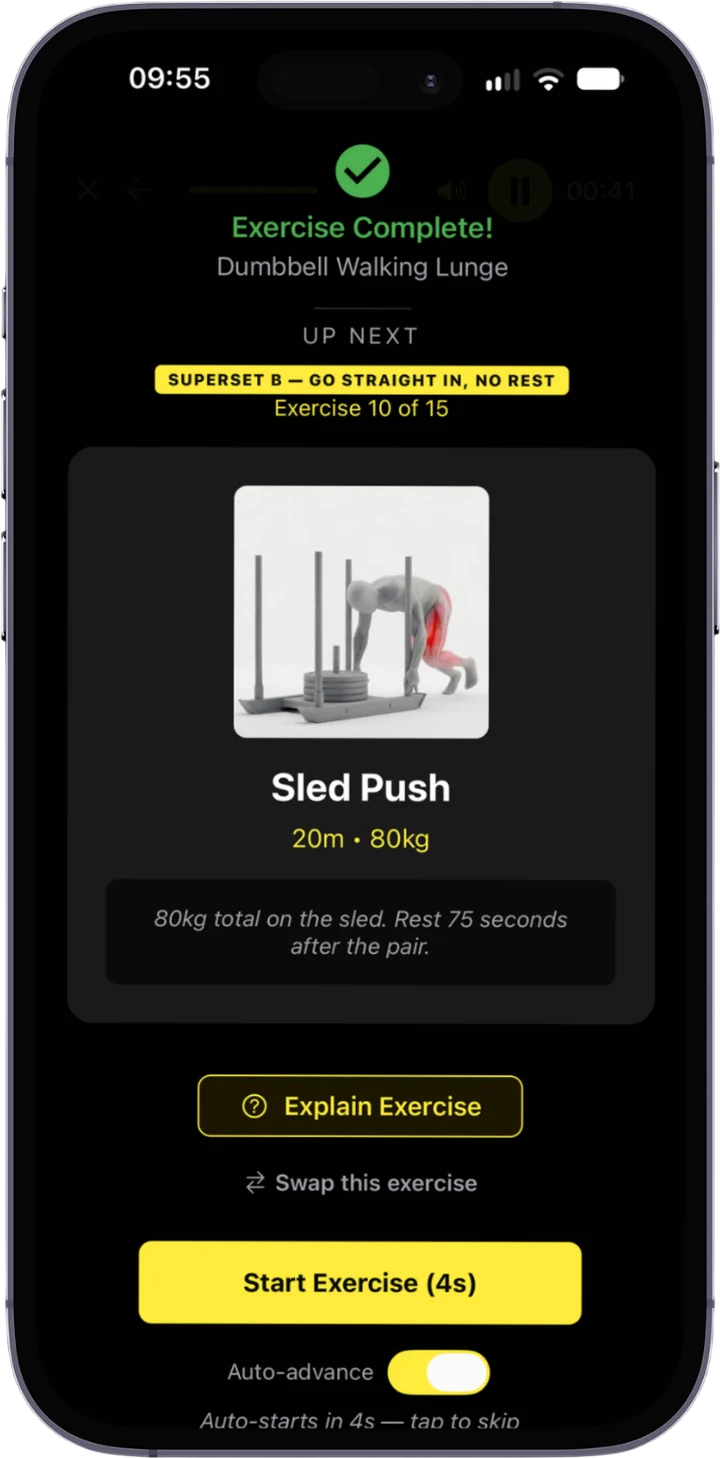
Technique: what the fast athletes do
01Low body angle, locked armsHands high on the uprights, arms straight, shoulders behind the hands, body as close to forty-five degrees as the sled will let you hold. Bent arms turn a leg exercise into a shoulder exercise.
02Short steps, constant contactChoppy strides with a foot always on the floor keep the sled moving. Long strides create a stop-start rhythm and every restart pays the static friction tax again.
03Never stop mid-lengthGetting a stationary sled moving again costs five to eight seconds. If you have to break, break at the turn where you are stopping anyway.
04Read the lane before you startLanes wear differently through a race day. Watch two heats if you can and take the cleaner carpet.
05Breathe out on every pushHolding your breath for fifty metres is why athletes arrive at run 3 seeing spots.
The standard, by division
| Division | Standard |
|---|---|
| Open Men | 152 kg total sled weight |
| Open Women | 102 kg |
| Pro Men | 202 kg |
| Pro Women | 152 kg |
Set by HYROX and they can change between seasons. Check the rulebook on hyrox.com and the judging brief at the venue.
Train it
Sled push workouts Sessions from the library built around this station. Put it in a plan Your race date in, a week-by-week plan out.
The other seven
Questions people ask
Is a slow sled push a strength problem or a fitness one?
Moved it in bursts, then stood over it? That is strength: heavy leg work and loaded sled pushes. Moved it steadily but slowly? That is technique and fitness: repeat 12.5 m pushes at race weight on short rest.
How do I test which one it is?
Do the station fresh and timed at race weight, then compare it with your race split. Much faster fresh: it is fitness. Slow even fresh: it is strength or technique.
Why does it matter which one it is?
They need different weeks. Strength needs heavy, low-rep work and takes 6 to 12 weeks to show. Fitness needs the movement done tired, after intervals, and shows in 3 to 4 weeks.
How much is the sled push worth training?
It is about 4% of a typical Open Men race. The top 10% are 45s faster here than a typical finisher. That ranks #5 of the 8 stations. #1 is the wall balls (2:15).
Are Pro and Doubles splits published?
Not per station yet. Pro weights are heavier, so expect Pro splits close to the Open typical or a little slower. HYROX sets the weights and can change them between seasons: check hyrox.com before you race.
Which HYROX are you doing?
Tap your race. You get your weeks to go, the finish time to expect, and week 1 of a plan for it. Free.