
Most people entering their first HYROX do not need more fitness advice. They need to know what the day looks like.
Almost everything that costs a first-timer time is procedural. Starting too fast, queuing in the roxzone, wall ball no-reps, or arriving hours before an afternoon wave.
This guide covers the day. The training is on the plan builder.
Are you ready? The only three tests that matter
Forget readiness quizzes. Three checks tell you almost everything.
Can you run 8 kilometres? Not fast. Just in one piece, on a flat surface. HYROX is eight 1 km runs with a station after each, and running is roughly half the race.
In Open races with full splits, the typical man runs for 41:41 and the typical woman for 46:46. Stations take them 38:42 and 41:27.
If 8 km in one go is out of reach today, you can still finish. Plan to walk parts of runs 6 to 8, and set your target to match.
Can you do 100 wall balls? Broken, with rest, in any number of sets. It is the last station and the one with the widest spread in the race.
The top 10% of Open Men finish it in 5:00. The slowest 10% take 11:49. If you have never done 100 in a session, do it once before race day.
Can you hold something heavy for 200 metres? The farmers carry is 2 × 24 kg for Open Men and 2 × 16 kg for Open Women.
It is the shortest station in the race, with typical times of 2:13 for men and 2:21 for women. It only stays short if your grip holds.
Three yeses means you are ready to race, not just survive. A no tells you what to train, and the beginner workouts are built around exactly these gaps.
The race, in order
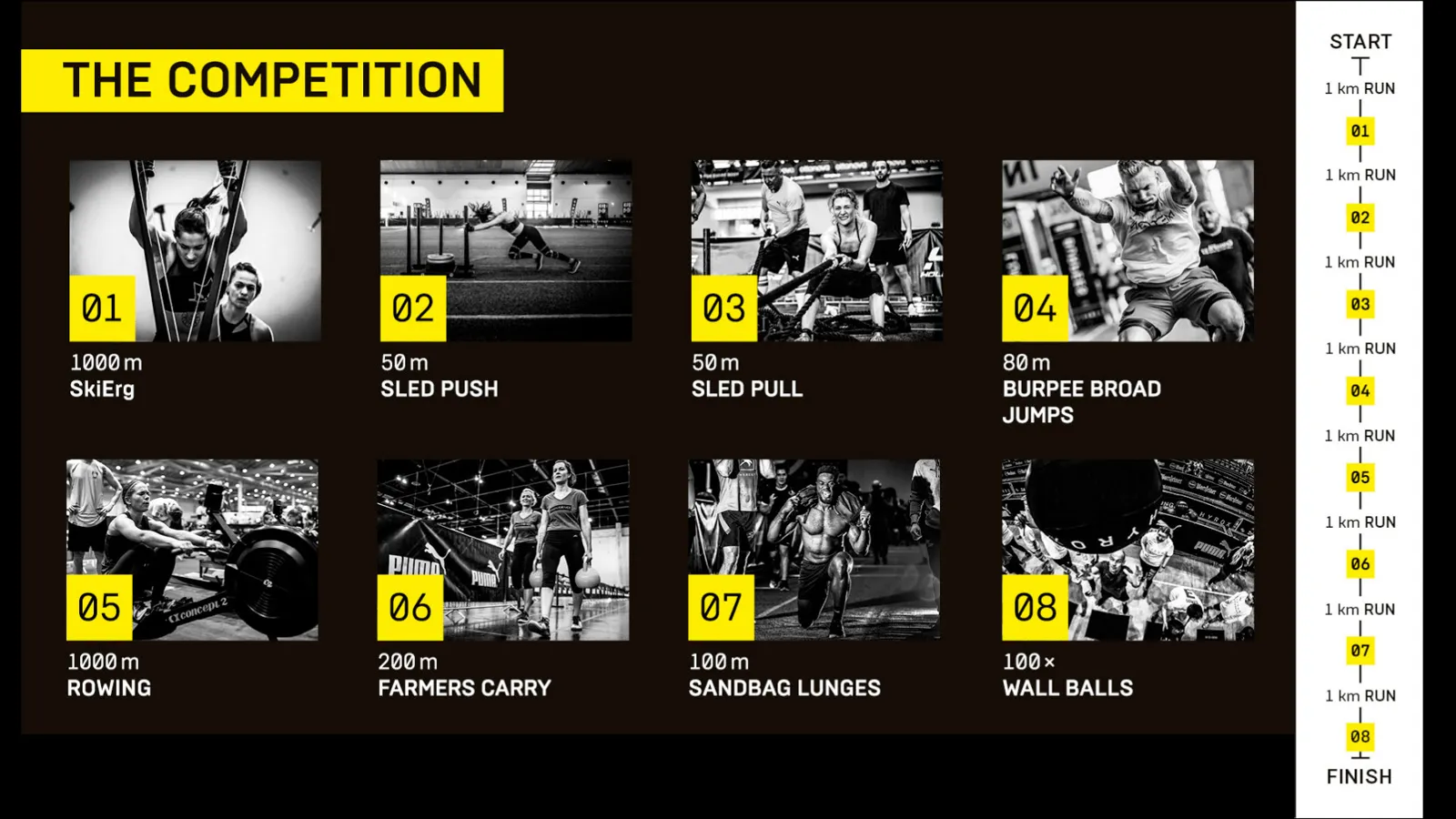
Eight runs of 1 km, each followed by a station, always in this order:
- 1000 m SkiErg
- 50 m sled push
- 50 m sled pull
- 80 m burpee broad jumps
- 1000 m row
- 200 m farmers carry
- 100 m sandbag lunges
- 100 wall balls
Between every run and station is the roxzone, a corridor you move through on foot. It is timed as part of your race.
The order matters for pacing. The two sleds come early, when you are fresh enough to bury yourself and pay for it later.
Burpee broad jumps at station 4 are where many first races quietly fall apart. Wall balls come last, so whatever you have left decides the finish. Read the pacing guide before you set a target.
What to wear
Shoes are the only real decision. You want grippy rubber and a stable base, because the sled push happens on a smooth indoor floor.
A running shoe with good grip suits most first-timers. A very soft, tall shoe can slip on the sleds. Whatever you choose, race in shoes you have trained in. The full breakdown is in the gear guide.
Socks above the ankle. The sled rope runs past your lower legs, and every lunge drags your back foot near the floor. Low socks leave that skin exposed.
Fitted kit, nothing loose. A vest or fitted top, and shorts or tights. Anything that flaps can catch on the sled rope or the sandbag.
Empty pockets. Phones, headphones and earbuds are banned on the race floor.
Gloves are optional. They help on the sled pull rope and the farmers carry handles. Grips are not allowed, and whatever you start with you carry to the finish.
Chalk, no-reps and the rules that catch people out
The rules come from one rulebook and apply at every venue. These catch first-timers most often.
Chalk only where HYROX puts it. Chalk is allowed at the sled pull and the farmers carry only, and only the chalk HYROX provides. Your own chalk, or chalk at any other station, is a two-minute penalty.
Wall ball standards are strict. Hips below the knees at the bottom. The ball must strike the target. Then catch it, or let it drop and stand tall with it before the next rep.
You cannot catch it off a bounce and go straight into the next rep. There are no warnings at the wall balls: a bad rep is a no-rep, and you do it again.
Lap counting is yours. The runs are laps of a marked course. Counting them is your job at every venue, and any lap screen is only a guide.
A missed lap costs 3 to 7 minutes, depending on the course. An extra lap costs you the time and nobody gives it back.
Movement standards, then penalties. At stations 1 to 7 you get one warning per station. After that, most faults cost 15 seconds each.
Two more worth knowing. The rower and SkiErg dampers start at 6, and you can change them. On burpee broad jumps, your chest must touch the floor and both feet must take off and land together.
The complete list is in rules and penalties.
Wave timing and the shape of your day
You are given a start time in a wave. Waves go off at regular intervals, often every ten minutes, from morning to evening. Your whole day keys off that time.
Check your start time as soon as you get it. It is sent before race day and confirmed at check-in. An afternoon wave means a completely different day from an early one.
Arrive about 90 minutes before your wave. That covers check-in, bag drop, finding the warm-up area and warming up. Bring photo ID and your registration confirmation.
Three hours is too early. The venue is loud and there is nowhere comfortable to wait.
Warm up close to your wave, not when you arrive. Ten minutes easy, leg swings and strides, a few light wall balls if there is a warm-up rig. Then keep moving.
Be at the start tunnel 10 minutes before your start time. That is a rule, not advice. It is where you get the race briefing.
Your bag goes to bag drop. You will not see it until you finish, so pack what you want straight after the race.
The three things that cost first-timers the most
- Run 1 too fast. The typical Open Man runs 4:33 for run 1 and 5:55 for run 8. The top 10% slow down far less. Starting 20 seconds per kilometre too quick costs minutes later.
- Sled push at full effort. It is 50 metres. Sprint it and you carry a pounding heart rate into the next run. Push steadily, with short pauses if you need them. Sled push splits and technique.
- Wall balls unbroken. Very few first-timers do 100 unbroken, and trying usually ends in a long stand-around. Pick sets of 10 or 15 from rep one, with five breaths between. Wall ball splits.
After the finish line
Keep walking. Get your kit. Then look up your splits: every run and station is timed on its own.
The benchmark tables show where each split sits against your division and age group. That comparison is the most useful thing your first race gives you. Build your next block from it.
Ready to build that block? Start at the plan builder and pick your next date.