

HYROX is won and lost in the first fifteen minutes. Almost nobody believes that until they have raced badly once.
The fastest athletes are not the ones who attack the early stations. They are the ones whose eighth kilometre looks like their second. Here is what the split data shows, and what to do about it.
The run fade is the signature of a badly paced race
Every finisher’s eight runs are timed separately, so pacing is measurable. Across 175,919 Open Men’s races with full splits:
| Run | Typical | Top 10% |
|---|---|---|
| Run 1 | 4:33 | 3:46 |
| Run 2 | 4:49 | 4:00 |
| Run 3 | 5:12 | 4:16 |
| Run 4 | 5:11 | 4:15 |
| Run 5 | 5:22 | 4:22 |
| Run 6 | 5:14 | 4:16 |
| Run 7 | 5:14 | 4:16 |
| Run 8 | 5:55 | 4:40 |
The typical athlete’s run 8 is 82 seconds slower than run 1, a 30% fade. In the top 10% the fade is 54 seconds, about 24%.
Open Women show the same shape: 5:15 on run 1 to 6:32 on run 8, a 77-second fade at the typical.
Look at the middle of the table. Runs 3 to 7 sit within about ten seconds of each other. The race is not a steady decline. It is a drop, a plateau, then a collapse.
Run 3 comes straight off the sled push. Run 8 comes straight off the sandbag lunges.
What to do: run the first kilometre 15 to 20 seconds per km slower than your target average. It will feel absurdly easy. That is the point: you are buying runs 6, 7 and 8.
The roxzone is the most ignored six minutes in the race
The roxzone is the corridor between the run course and each station, and it is timed as part of your total.
Typical Open Men roxzone time is 7:42. The top 10% spend 5:21. The slowest 10% spend 11:25.
That is a six-minute range on a part of the race nobody trains, nobody judges, and many people do not know is being timed.
Going in to a station, you arrive on your running momentum. Going out is where time disappears: getting up from the sled, walking the corridor, shaking out your forearms, hesitating.
What to do: treat every station exit as part of the station. The moment the last rep lands, you are moving. Not sprinting. Moving.
Practise the transition itself: last rep, stand, three walking steps, jog. It is the cheapest minute in HYROX and it costs no fitness at all.
Use the right arches, too. Entering or leaving the roxzone through the wrong one is a 2-minute penalty.
Which stations are worth attacking
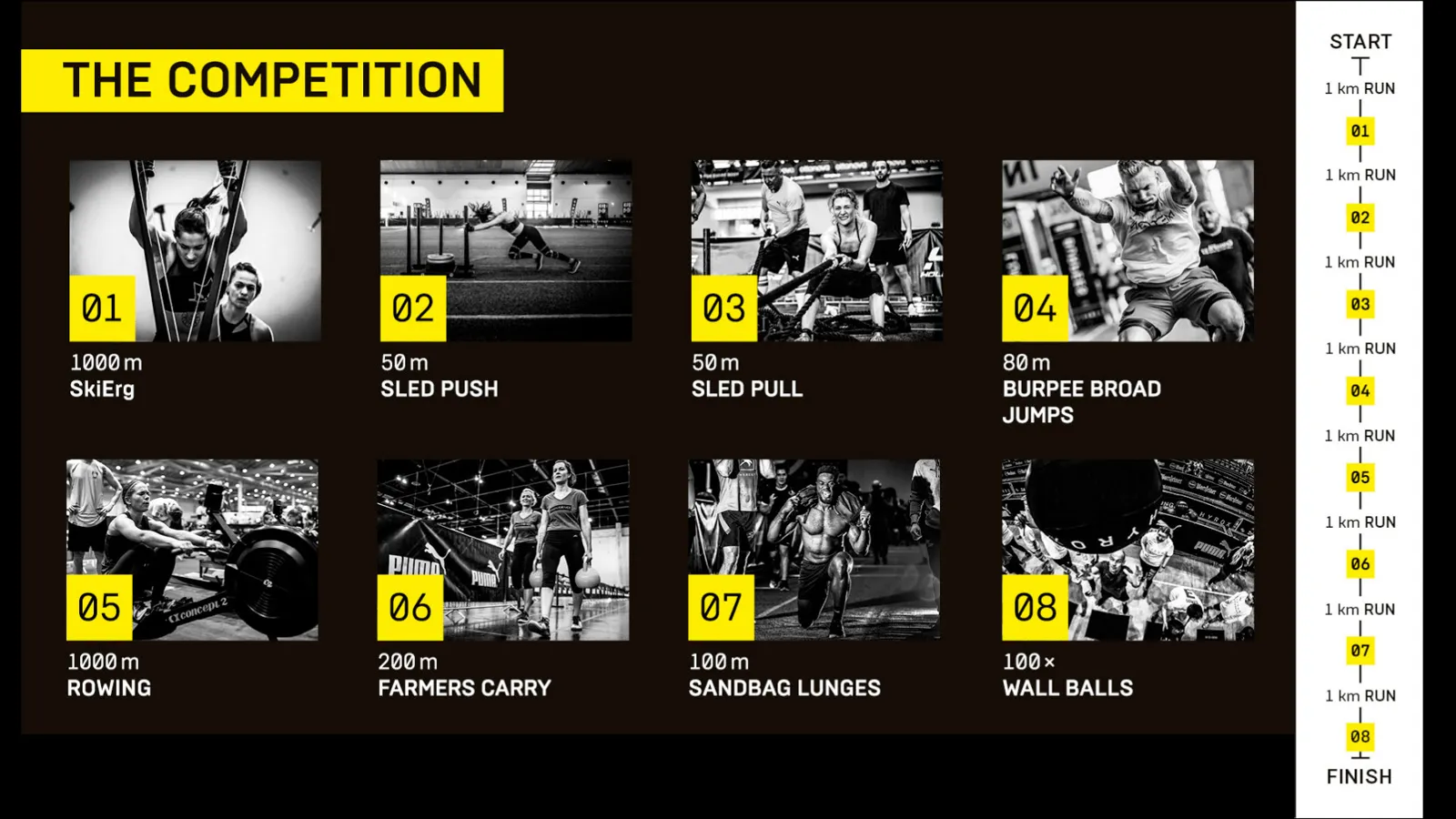
Not all stations reward effort equally. The gap between the typical and the top 10% shows where the time is (Open Men):
| Station | Typical | Top 10% | Gap |
|---|---|---|---|
| Wall balls | 7:15 | 5:00 | 2:15 |
| Burpee broad jumps | 5:38 | 3:54 | 1:44 |
| Sandbag lunges | 5:22 | 3:54 | 1:28 |
| Sled pull | 5:03 | 3:46 | 1:17 |
| Sled push | 3:10 | 2:25 | 0:45 |
| Farmers carry | 2:13 | 1:41 | 0:32 |
| Row | 4:55 | 4:25 | 0:30 |
| SkiErg | 4:36 | 4:14 | 0:22 |
The two ergs are the narrowest stations in the race. Only 22 seconds separates a typical SkiErg from a top-10% one.
Chasing those seconds costs a raised heart rate you pay for on the next kilometre, and maybe the one after. Ski and row are pacing stations, not scoring stations. Settle in, hold a steady rate, and leave.
Wall balls, burpees and lunges are where the minutes are. All three reward technique and a planned set structure, which is why they respond so well to training: wall balls, burpee broad jumps, sandbag lunges.
What the fast quartile actually does
Four things show up in the fast end of the field.
Their early slowdown is smaller. In the top 10%, run 3 is 30 seconds slower than run 1. For the typical athlete it is 39 seconds, because run 1 was spent banking time.
They break stations before they have to. A planned wall ball structure such as 20-15-15-15-10-10-10-5, with five breaths between sets, starts slower and finishes faster.
The alternative is going unbroken until failure, then short sets, then long pauses. That usually costs more than it saves.
They leave the sled with something left. The typical sled push is 3:10 and the top 10% do 2:25: only 45 seconds apart. But the run straight after is where pace falls off.
Burying yourself on the sled to save 20 seconds, then losing 40 on the next kilometre, is a bad trade.
They move in the roxzone. See above. It is six minutes.
Building your target pace
Work backwards. Pick a realistic finish from the benchmark tables or the race time predictor.
Subtract a realistic station total and a realistic roxzone time (use 8 minutes unless you know better). Divide what is left by eight. That is your target pace per kilometre, and your first kilometre should be slower than it.
For the typical Open Man with full splits, the finish is 1:28:43: about 41:41 of running, 38:42 of stations and 7:42 of roxzone.
The running target is therefore about 5:12 per kilometre. Run 1 should be about 5:30, not 4:33.
Train the pacing, not just the fitness
Pacing is a skill, and you train it by running at race pace on tired legs. Try 800 m repeats at goal pace with 20 air squats before every other one.
In the peak phase, do a partial race simulation where you execute the plan and record the splits. Both are built into the plan builder by phase.
There are ready-made sessions in the running and endurance category and the race simulation workouts.
Then read the rules and penalties guide. A pacing plan that ends in ten wall ball no-reps was not a pacing plan.