

The masters conversation in HYROX usually runs on gut feel. The results data is better than gut feel.
Across 277,545 Open finishes, a decade costs less than most people assume until about 55. And the spread inside any age group dwarfs the gap between age groups.
Here is what the numbers say, and what actually changes in a training block after 40.
What a decade costs
Open Men, by age group:
| Age group | Finishers | Top 10% | Typical | Slowest 10% |
|---|---|---|---|---|
| 25–29 | 32,960 | 1:08:26 | 1:25:19 | 1:55:14 |
| 30–34 | 41,242 | 1:09:00 | 1:25:50 | 1:55:19 |
| 35–39 | 35,217 | 1:10:29 | 1:27:23 | 1:56:11 |
| 40–44 | 23,897 | 1:12:13 | 1:29:17 | 1:58:11 |
| 45–49 | 13,543 | 1:13:54 | 1:31:06 | 2:00:32 |
| 50–54 | 7,268 | 1:16:38 | 1:34:28 | 2:04:13 |
| 55–59 | 3,643 | 1:19:54 | 1:38:35 | 2:08:38 |
| 60–64 | 1,793 | 1:21:06 | 1:40:52 | 2:15:09 |
| 65–69 | 556 | 1:26:20 | 1:50:36 | 2:28:06 |
Open Women, same cut:
| Age group | Finishers | Top 10% | Typical | Slowest 10% |
|---|---|---|---|---|
| 25–29 | 22,300 | 1:17:07 | 1:34:26 | 2:04:17 |
| 30–34 | 21,762 | 1:17:13 | 1:34:55 | 2:06:22 |
| 35–39 | 17,342 | 1:18:06 | 1:36:08 | 2:06:58 |
| 40–44 | 11,950 | 1:18:59 | 1:36:53 | 2:07:46 |
| 45–49 | 7,105 | 1:20:04 | 1:38:29 | 2:12:27 |
| 50–54 | 3,590 | 1:22:00 | 1:40:30 | 2:13:21 |
| 55–59 | 1,589 | 1:25:40 | 1:45:26 | 2:21:57 |
| 60–64 | 763 | 1:23:08 | 1:45:47 | 2:17:08 |
| 65–69 | 193 | 1:34:54 | 1:57:23 | 2:37:14 |
Read the 40s carefully. The typical Open Man at 40–44 finishes in 1:29:17. At 25–29 it is 1:25:19.
Fifteen years costs about four minutes at the typical, roughly 4.7%. For women the same span costs about two and a half minutes. That is around 0.3% a year.
It may even overstate what ageing does. Older age groups include more people who took up the sport recently.
The curve steepens from 55. The typical 55–59 man is four minutes slower than the typical 50–54 man, and 65–69 is almost ten minutes slower than 60–64.
Even so, the top 10% of 60–64 men (1:21:06) beat the typical 30–34 finisher (1:25:50) by more than four minutes.
The useful conclusion: your training history predicts your time far better than your age group does. Among 45–49 men there are 46 minutes between the top 10% and the slowest 10%. Between the 25–29 and 45–49 typical finishes there are under six.
What actually changes after 40
Four things change in a way that should change your plan. None of them are reasons to train less.
Hard sessions need more space. The session itself is rarely the problem. The second hard session 36 hours later is.
Stacking two high-intensity days is the most common way masters athletes waste training. You get the benefit of neither.
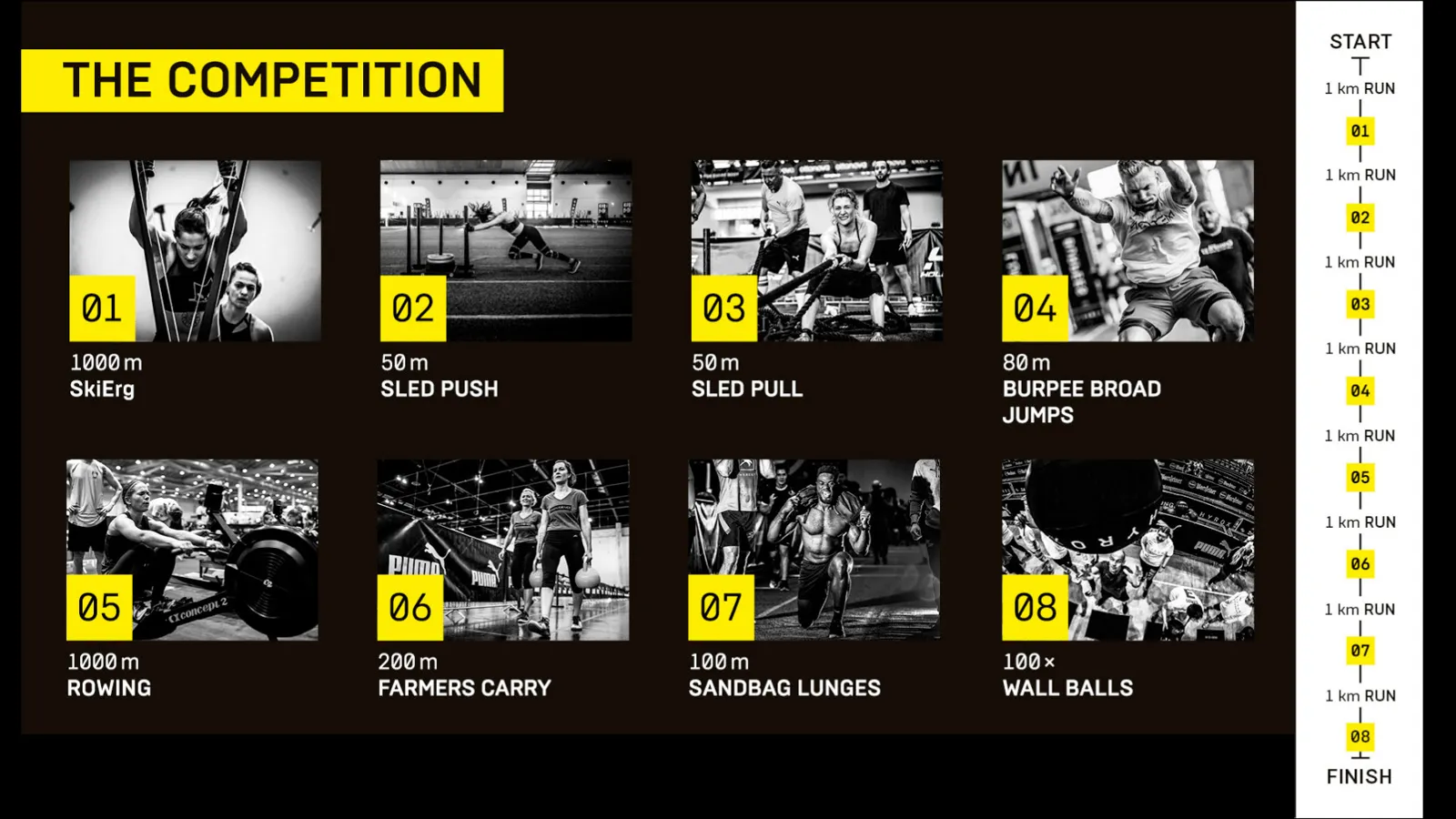
The leg-heavy stations slow down most. In the 2025/26 Open results, men aged 45–49 run about 6% slower than men aged 25–29. On wall balls, sandbag lunges and burpee broad jumps they are about 13% slower.
The SkiErg, the row and the farmers carry barely move. Women show the same pattern, a little milder. So keep leg strength and loaded lunging in the plan. Dropping strength work as you get older is backwards.
Running volume needs building slowly and holding steadily. The aerobic base is the most durable thing you build, and it rewards uninterrupted months. Three runs every week beats five runs for a fortnight, then a fortnight off.
Movement quality needs deliberate practice. Not as a warm-up ritual, but as part of the session. 100 metres of lunges with a knee touch every rep, and 100 wall balls to full depth, are standards problems before they are fitness problems.
See the standards in the rules and penalties guide.
How to space the week after 40
A four-day masters week that works:
| Day | Session | Why |
|---|---|---|
| Monday | Strength: squat, hinge, carry, press | Hard day, 48h before the next hard day |
| Tuesday | Easy run, 30–40 min | Aerobic, genuinely easy, helps you recover from Monday |
| Thursday | Hybrid: run intervals with station work between | The race-specific hard day |
| Saturday | Long run, building to 60–75 min | Aerobic volume, low intensity |
Two hard days, two easy days, three full rest days.
The plan builder’s four-day option uses the same four days. Its Tuesday session is run intervals, so after 40 keep that run easy in any week when Monday’s strength session left you tired.
Three adjustments to make inside the week:
- Take the deload weeks. Every fourth week the plan cuts the work by about a third. Younger athletes get away with skipping them. After 40, the deload is where the previous three weeks turn into fitness.
- Keep the strength heavy and the volume low. Four sets of five at a genuinely hard weight, not four sets of fifteen. The high-rep version takes longer to recover from.
- Lengthen the block rather than raising the intensity. A 16-week build with steady progress beats an 8-week block run at 100%. The 16-week plan is a good fit for a masters athlete with a date in the diary.
Where to spend your training time
The station gaps say the same thing for masters athletes as for everyone else, only more so. For Open Men, the biggest gaps between the typical and the top 10% are:
- Wall balls: 7:15 against 5:00.
- Burpee broad jumps: 5:38 against 3:54.
- Sandbag lunges: 5:22 against 3:54.
Those are also the three stations that slow most with age. The ergs are nearly fixed costs: only 22 seconds separates a typical SkiErg from a top-10% one.
Then there is the roxzone, the corridor between runs and stations. The top 10% of Open Men spend 5:21 in it and the slowest 10% spend 11:25.
Moving briskly out of every station is worth more than most single-station gains, and it costs nothing in recovery. The details are in the pacing strategy guide.
Setting a target
Find your age group in the tables above, then decide which band you are going after.
Moving from the typical to the top quarter of a 45–49 field is about ten to twelve minutes. That is realistically one well-run 12 to 16 week block. Most of the gain comes from the run fade and the three leg-heavy stations, not anything exotic.
Full numbers by division, gender and age are in the benchmark tables. There are ready-made sessions for older athletes in the age and ability workouts.
When you have a date, build the block on the plan builder.