

Race week cannot make you fitter. It can definitely make you slower.
The last seven days are about arriving with the fitness you built still available. The ways it goes wrong are boring and preventable: too much training, poor sleep, a chaotic travel day, and a warm-up done far too early.
The taper: less volume, some intensity, same movements
The pattern is the same across endurance sport. Cut volume hard, keep a little intensity, and keep the movements familiar.
Volume comes down by roughly two thirds. If your normal week is four sessions and three and a half hours, race week is two short sessions and about an hour.
Intensity does not go to zero. Do nothing for seven days and you arrive flat. Keep it short and sharp: enough to remind your legs what fast feels like, not enough to need recovery.
Nothing new. No new shoes, no new movement, no first attempt at anything. Race week is the worst time to discover something.
A week that works, for a Saturday race:
| Day | Session |
|---|---|
| Monday | Easy 20–25 min run, relaxed. A few strides at the end. |
| Tuesday | Short primer: 2 rounds of 800m at race pace, 10 wall balls, 10 lunges. About 30 minutes. Stop while it still feels good. |
| Wednesday | Nothing, or 20 minutes of easy walking. |
| Thursday | Optional 15-minute jog with 4 strides. Check your kit. |
| Friday | Travel. Walk, do not sightsee for six hours. |
| Saturday | Race. |
That is it. The final week of every plan builder block is a taper on the same idea, scaled to your level.
Sleep: the night that matters is Thursday
Most people sleep badly the night before a race: noise, nerves, a strange bed, an early alarm. That is normal, and one poor night matters less than people fear.
The nights before it matter more. Aim for good sleep from Tuesday to Thursday rather than forcing eight hours on Friday.
Keep your normal wake time and get outside in daylight early. If you are crossing time zones, start shifting towards race-day timing as soon as you book.
If your wave is at 7am and you normally wake at 8, practise the early alarm twice during the week. Race morning should not be the first time.
Eating and drinking
Keep it simple: eat what you normally eat, at the times you normally eat. The most common race-week mistake is trying a new pre-race meal or drink for the first time on race morning.
On race day, have your usual breakfast at your usual gap before a hard session. For most people that is two to three hours. Then stop eating.
Sip fluids through the morning rather than drinking a lot just before your wave. You do not want to be looking for a toilet at the start tunnel.
During the race, water is on offer at least once each time you pass through the roxzone. If you want anything to eat during the race, you must carry it from the start. Nobody can hand you anything.
If your wave is in the afternoon, treat it as a normal day, with a normal breakfast and a light lunch three hours out.
Logistics: the list
Do this on Thursday, not Friday night.
Kit bag:
- Race shoes, the ones you have trained in. Grippy rubber and a stable base for the sled.
- Socks above the ankle, for the lunges and the sled pull.
- Fitted top and shorts or tights. Nothing loose.
- Gloves, if you race in gloves and have trained in them. No grips.
- A heart rate strap and a charged watch, if you use them.
- A spare top for after.
- Photo ID and your registration confirmation. You need both at check-in.
Leave out: headphones, earbuds and your own chalk. Headphones are banned on the race floor. Only HYROX’s chalk is allowed, and only at the sled pull and farmers carry.
Know before Friday:
- Your start time. It is sent before race day and confirmed at check-in. A 7:20am wave and a 4:40pm wave are completely different days.
- The venue address, and how long it really takes to get there on race day.
- Where check-in and bag drop are.
- That your division’s weights and wall ball target match what you trained with.
The full kit breakdown, including what is worth spending money on, is in the gear guide.
Arrival and the warm-up
Arrive about 90 minutes before your wave. That covers check-in, bag drop, a look at the floor, a proper warm-up and a toilet queue. Much longer, and you are standing in a loud hall burning nervous energy.
At check-in you get your timing chip, which goes on your ankle, and a wristband that shows your wave and division.
Walk the floor if you can. Find where the roxzone runs, where the sleds sit and where the wall balls are. Knowing the layout is worth real seconds and a lot of calm.
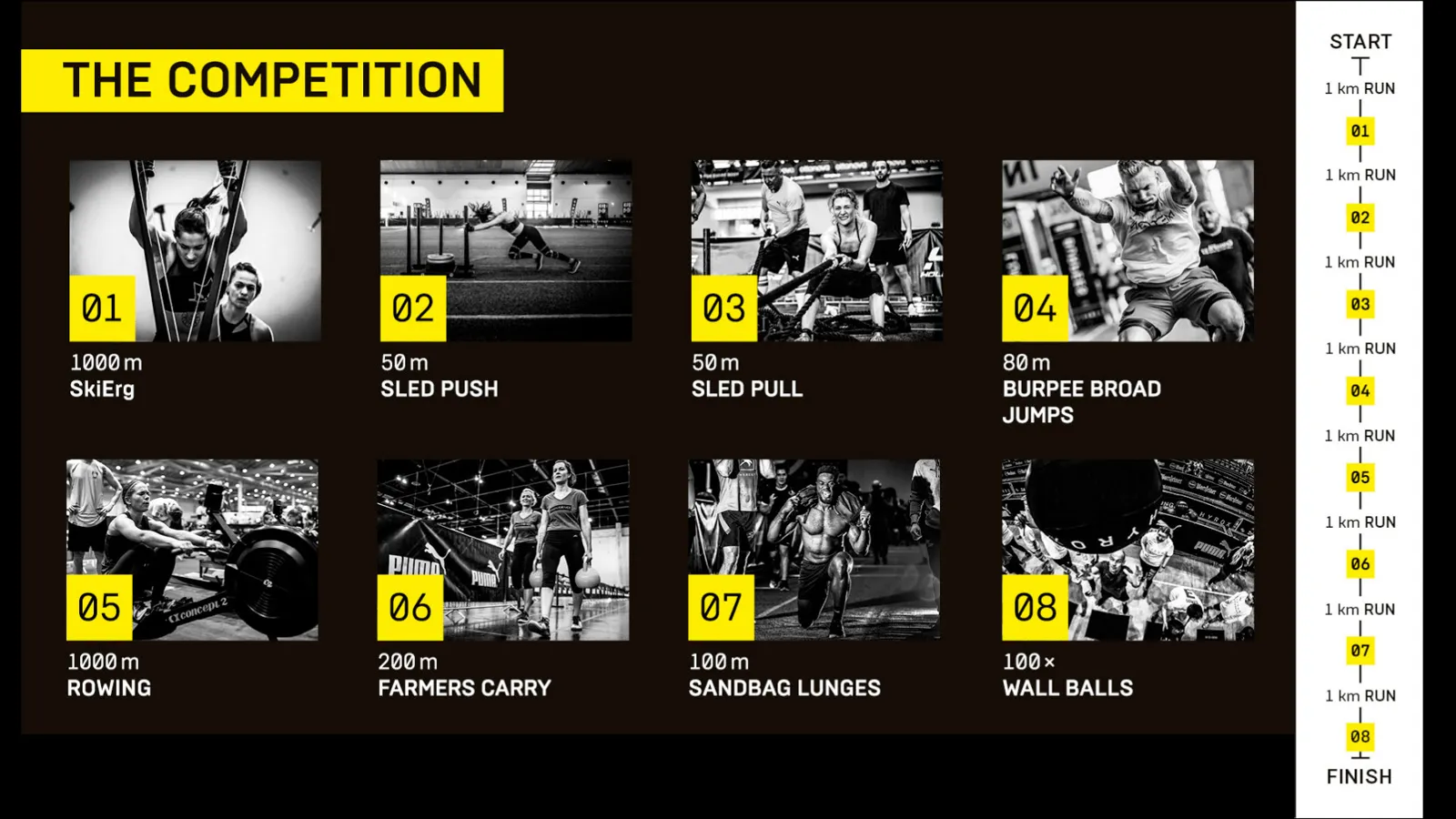
Check how many laps make up each 1 km run. Counting them is your job, and a missed lap costs minutes. See rules and penalties.
Warm up close to your wave time, not when you arrive. Around 25 to 30 minutes out: 8 to 10 minutes of easy jogging, leg swings and hip openers, and 4 strides.
Then a few light wall balls and a couple of easy sled pushes, if the warm-up area has them. Keep moving until you are called. Sitting down undoes the warm-up.
Be at the start tunnel 10 minutes before your start time. That is a rule. It is where you get the race briefing.
Say your plan in one sentence before you start. For example: “Run 1 at 5:30, wall balls in tens from the start, move in the roxzone.” A plan you can say out loud is a plan you still remember at station 6.
The numbers behind it are in the pacing strategy guide.
The first five minutes
The wave goes and the people around you set off faster than they can hold. You will feel slow. You are not slow. They are wrong.
The typical Open Man runs run 1 in 4:33 and run 8 in 5:55. That 82-second fade is the first kilometre being run on adrenaline.
Hold your number. Let the first run be boring. The race starts at the burpees.
After
Keep walking for five minutes and collect your bag. In the next few days, look up your splits: every run and station is timed.
Compare them with your division and age group in the benchmark tables. They tell you what the next block should be about.
Then set the next date in the plan builder. The week after a race is the easiest week of the year to plan, and the easiest to waste.
For taper-week sessions you can follow directly, see the race simulation and race-week workouts.