
Average HYROX time by age group, men and women
The fastest Open Men age bracket is 25-29, with a typical of 1:25:19. For Open Women it is 25-29 at 1:34:26.
From there the curve bends far more gently than most people expect. By 50–54 the typical is only about 9.1 minutes slower for men and 6.1 minutes for women. Not an hour. Not a division. Minutes.
Below are full numbers for every five-year bracket from 16–24 to 75–79, for both genders, from 277,545 Open finishes.
Masters athletes, 40 and over, make up about 27% of the Open field in this data. That is why most masters brackets here have thousands of finishers, not a handful.
Every age group, Open Men and Open Women
| Age | Men | Women | ||||||
|---|---|---|---|---|---|---|---|---|
| Finishers | Top 10% | Typical | Slowest 10% | Finishers | Top 10% | Typical | Slowest 10% | |
| 16-24 | 16,946 | 1:08:33 | 1:26:01 | 1:55:40 | 13,597 | 1:17:48 | 1:35:55 | 2:06:08 |
| 25-29 | 32,960 | 1:08:26 | 1:25:19 | 1:55:14 | 22,300 | 1:17:07 | 1:34:26 | 2:04:17 |
| 30-34 | 41,242 | 1:09:00 | 1:25:50 | 1:55:19 | 21,762 | 1:17:13 | 1:34:55 | 2:06:22 |
| 35-39 | 35,217 | 1:10:29 | 1:27:23 | 1:56:11 | 17,342 | 1:18:06 | 1:36:08 | 2:06:58 |
| 40-44 | 23,897 | 1:12:13 | 1:29:17 | 1:58:11 | 11,950 | 1:18:59 | 1:36:53 | 2:07:46 |
| 45-49 | 13,543 | 1:13:54 | 1:31:06 | 2:00:32 | 7,105 | 1:20:04 | 1:38:29 | 2:12:27 |
| 50-54 | 7,268 | 1:16:38 | 1:34:28 | 2:04:13 | 3,590 | 1:22:00 | 1:40:30 | 2:13:21 |
| 55-59 | 3,643 | 1:19:54 | 1:38:35 | 2:08:38 | 1,589 | 1:25:40 | 1:45:26 | 2:21:57 |
| 60-64 | 1,793 | 1:21:06 | 1:40:52 | 2:15:09 | 763 | 1:23:08 | 1:45:47 | 2:17:08 |
| 65-69 | 556 | 1:26:20 | 1:50:36 | 2:28:06 | 193 | 1:34:54 | 1:57:23 | 2:37:14 |
| 70-74 | 129 | 1:36:02 | 1:59:24 | 2:40:54 | 55 | 1:36:43 | 2:10:30 | 2:46:34 |
| 75-79 | 16 | — | 2:19:12 | — | 6 | — | 2:17:48 | — |
| All | 177,264 | 1:10:11 | 1:27:49 | 1:57:37 | 100,281 | 1:18:08 | 1:36:08 | 2:07:26 |
Brackets with fewer than 30 finishers show a typical only — a top-10% cut off a sample of six is noise, not a benchmark.
The shape of the age curve
Each strip runs from the bracket's top-10% cut to its slowest-10% cut, with the typical marked in yellow.
Two things stand out once it is drawn. First, the strips barely move until the fifties. The typical slows by a couple of minutes per bracket, not in a sudden step.
Second, the strips get wider in the oldest brackets. Older fields are more varied, because training history and consistency matter more and more.
For Open Men, the typical is 1:29:17 at 40–44, 1:34:28 at 50–54 and 1:40:52 at 60–64. For Open Women it is 1:36:53, 1:40:30 and 1:45:47.
A 50-year-old man in the top 10% of his bracket (1:16:38) is faster than the typical 25-year-old.
Compare yourself to your own bracket, not the field
Your age group, your place in it
Set your division, category and age bracket, then type your finish time. Your place is measured against your bracket, not the whole field.
What actually changes with age — and what does not
The station splits tell the story better than the finish times. In the 2025/26 Open results, station work slows a little faster with age than running does.
Men aged 45–49 run about 6% slower than men aged 25–29. On wall balls, sandbag lunges and burpee broad jumps they are about 13% slower. The SkiErg, the row and the farmers carry barely move. Women show the same pattern, a little milder.
So for anybody over forty, the best training week is not a younger athlete's week with less in it. It is plenty of easy running, fewer all-out efforts, and regular leg strength and lunge work.
Leave enough recovery between hard days that the easy sessions actually happen. The table below shows where the top 10% of Open Men find their time.
A top-10% Open Men finish is 16:48 faster than a typical one. The stations below are sorted by how much of that they win.
| Station | Top 10% | Typical | Slowest 10% | Top 10% saves | Where the time is |
|---|---|---|---|---|---|
| Wall balls | 5:00 | 7:15 | 11:49 | 2:15 | |
| Burpee broad jumps | 3:54 | 5:38 | 8:31 | 1:44 | |
| Sandbag lunges | 3:54 | 5:22 | 7:57 | 1:28 | |
| Sled pull | 3:46 | 5:03 | 7:04 | 1:17 | |
| Sled push | 2:25 | 3:10 | 4:26 | 45s | |
| Farmers carry | 1:41 | 2:13 | 3:09 | 32s | |
| Rowing | 4:25 | 4:55 | 5:36 | 30s | |
| SkiErg | 4:14 | 4:36 | 5:06 | 22s |
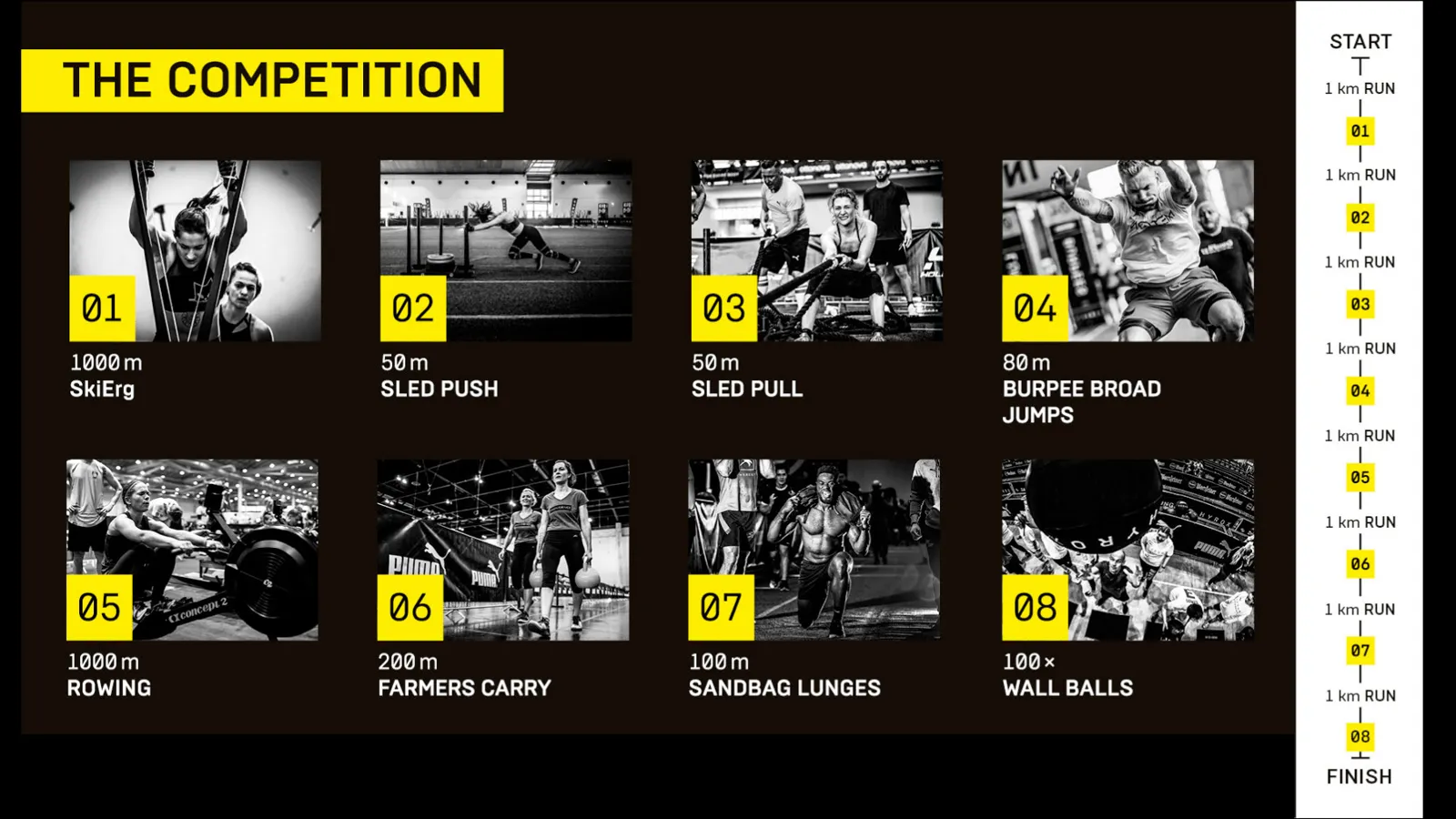
Each station's page has the standards, the weights for every division, and a check on whether your split is a strength problem or a fitness one: station benchmarks index.
Where these numbers come from
Age brackets follow the official HYROX five-year age groups and come straight from the 2025/26 season results, not from estimates.
Times are cleaned first. A finish of zero or under forty minutes is treated as a data error. Any single segment more than three to five times its group's typical is flagged. A group whose typical comes out at zero is left out, not published.
One caveat: age brackets are not age-graded. A 55-year-old at the typical of 55–59 and a 28-year-old at the typical of 25–29 are both exactly average for their bracket.
Comparing their raw times tells you nothing useful. For a fair comparison across ages, use your place within your own bracket, which is what the widget above gives you.
The rest of the benchmarks
Straight to a station: SkiErg · Sled push · Sled pull · Burpee broad jumps · Rowing · Farmers carry · Sandbag lunges · Wall balls
Your bracket. Your date. Your plan.
A week-by-week build that accounts for your age group, your recovery and the stations that are actually costing you time.
- Built from your race date and level
- Rebuilt every week from what you did
- Every station, every run, timed in the app